


August 2026

Most artists who start out as singer-songwriters stay within this troubadour niche even if they famously turn electric – but Claire Hamill is different from most musicians who fall into this category. Admitting to being a bit adventurous, she hasn’t become predictable over the last five and a half decades, as such albums as 2026’s "A House Among The Trees" suggest, and, what’s more, she hasn’t grown cynical and still finds wonders in the world, even though the state of its affairs sometimes makes her angry. The lady charted her own trajectory on Island Records, accompanied on her platters by elite players, opened for KING CRIMSON – alone with her guitar, unafraid to precede their raucous menace – and even wrote a piece with Robert Fripp, worked with Ray Davies and sang with WISHBONE ASH, yet she always delivered captivating melodies and words that capture her vision.
But then, Ms. Hamill is a captivating person with a lot of stories to tell.
– Claire, let me quote a lyric from “River Song” off your first album: “catching all the reflections from around you in the mirrors of your eye…” You seem to have had this knack of observation from the very beginning.
The thing is, that is not my lyric, unfortunately. I was a bit too young then to be writing anything of any great merit. But I did have a boyfriend [Mike Coles] who was an artist and a poet, so I took some of his poetry, to be perfectly honest, because I was only sixteen and I hadn’t really lived. I was a schoolgirl, and he was my first love. He was nineteen, a bit older than me, but just a natural artist. And I really believe that had I not met him and written those songs with his lyrics, I wouldn’t have got my recording contract at the time – I probably would have got one maybe a couple of years later, because it was still a very barren field of girls making music and writing songs. There were very, very few, so I think I would still have made a contribution, and even though my writing wasn’t very mature at the time I got my record contract, it did mature. But my style was already there, and my ability to hold an audience and put a song over, so I did have something there that I could build on at least. But I can’t claim to have written those beautiful words.
– Still, they so perfectly, for me at least, catch your method, this keen eye for detail. How did you become so observant to everything around you?
I think children who grow up with difficult parents are always watchful, and I had a very difficult father. He was very moody – when he’d been drinking, he was very happy; when he wasn’t, he was very angry. And that kind of atmosphere at home makes you very attuned to mood and makes you try to read the room, to understand people. That was possibly the beginning of it, the insecurity of my father’s moods: not knowing whether he was going to be in a good mood or a bad mood. But weirdly enough, one of my family did some research into our background, and apparently we were descended from druids of Ireland who held all the stories of the nation and of their culture – they could remember the stories and recount them. That made a lot of sense to me because, I had an ability at that time to remember lyrics, to describe them, to put them over to people, to hold the content and to sing and share it with others. I always had that ability – it’s meant to come from my father’s side of the family because the name Hamill is derived from O’Neill. They were the early kings of Ireland, the Uí Néills, but I don’t think we were related to the O’Neills – we’re an offshoot somewhere.
– What would a supposedly shy girl who grew up in those circumstances say if she listened to “My Snakeskin Lover” from your last album?
What a song, eh? (Laughs.) What a song! It’s a lot of fun, that song. It is a lot of fun. I do like to write with my tongue in my cheek. And that song also alludes to my family background. The last verse is about my children – my eldest daughter, in particular, who looks just like her father, while my middle one looks a bit more like me. I look at my eldest and I say, “What is there of me in you?” The only thing I could recognize is the black circle around her iris and I say, “I gave you that, at least!” – because her father doesn’t have that at all: he has very bright blue eyes, but without the black circle. So when I wrote that song, I put that line in: “But not my eyes, they’re from the man who was her snakeskin lover” – meaning my mother. You can have a great deal of fun with songs. That’s part of the pleasure of writing them, when you can come up with an idea like “My snakeskin lover shed me” – which is such a good line – “Then slithered off to be the ultimate king cobra to someone who looks like me”: I loved writing that first verse, and that set me on the way to develop the song. And when you can round it off with a good ending, it’s almost like filling in the last bit of the crossword puzzle – when you get the last clue and you put the last word in, you just go, “Ah!” (Laughs.)
As for your question, I don’t think I was ever really shy. I was known for being precocious, because I’m the eldest of seven children. I had to be quite outgoing, so my mother would notice me. “Hello, remember me? I was the first one!” (Laughs.) My mother had seven children in nine and a half years – that was pretty good going. So in some ways, I asked myself: Was my being drawn to performing in order to get attention, or was it just something that I had an ability to do? It came out, and then I couldn’t resist it. My father was involved in amateur dramatics, so I did get stagestruck when I saw him on stage, and I then wanted to be up there too. I’m not sure whether it was the attention or seeing what a wonderful world that could be, how much fun it could be. That started something in me, but the music was already there, because that’s an innate thing in my family. My grandma had a beautiful voice – my mother, my aunties, they all sang together. We were all good singers, but drama was the thing that I really wanted to do as a child.
I saw Judi Dench play Saint Joan on TV when she was about twenty [actually,31 – DME], and I was a young girl, and I was just blown away by her performance. I decided I wanted to be that, I want to be a serious actress and play Saint Joan, but even though I did do some drama at school, that never happened. I just went off down the songwriting and music route, and I think that’s worthwhile. It’s been a great ride so far, and I haven’t regretted it at all. I was in a musical six or seven years ago, and I couldn’t remember the bloomin’ lines. (Laughs.) It was terrible. I couldn’t remember any of the acting, all I could remember was the songs. I got completely out of the window, so I thought it was really funny.
– What was this musical that you were in?
It was called “Paris Snow” – written by an American who lived in France: a cute story about a young girl who finds out that her father had an affair and she falls in love with a chap that turns out to be her brother or something like that. I played a Russian nightclub owner called Magda, which was really funny because my ex-husband’s second wife was from Belarus, so I had the accent down and I knew how to be: (imitates Russian accent) “Yes, I am Magda. Yes, I have the nightclub. This is my son…” I really enjoyed the role, but the first night I just blanked, although the songs came out perfect. We rehearsed again and again, and I didn’t find it easy. I had absolutely no training, but I would have loved to have gone to drama school, and I never did – but my middle daughter went there, and I remember going around the school before she did. I was like, “Oh, oh, look at the props department! Oh, look at the costume department! Oh, isn’t it wonderful?” – until she told me, “Mom, will you please just shut up about how wonderful everything is?” (Laughs.)
– How did you land the role?
A local playwright came around to visit me – he had that part in mind and asked me if I’d like to get involved. I thought, “Yeah, why not? It sounds like a lot of fun!” And it was – I enjoyed it immensely. They were a lovely team, and the girl singer, who had an operatic voice, was wonderful. I stayed in touch with the man who wrote the songs and music for some years – he lived in Versailles – but we stopped messaging each other after Covid was over: I lost my phone and I had to change all my numbers, but I never got around to putting everybody that I knew in the world back in my phone. But he emailed me about a year ago with an idea that we would revive the musical, but we never did. It was meant to go to London, but it never transferred there, and that was the end of my acting career.
– Acting and singing are both performative arts. Only when you act, you’re being somebody else; and when you sing, you cannot be anyone else but yourself. So it’s very different.
That’s very true. You’re reaching into your own psyche in order to pull something out of it that might be helpful for another person, that might touch another person, that another person might relate to, or be just entertained by. So singing’s been more meaningful in many ways.
– How important is it for you to be yourself in your songs?
Very important. Sometimes I will take a part of myself and then make a fantasy story around it. There’s usually a kernel of me in there somewhere. For me personally, if you have a song that has meaning, then that’s a worthwhile song. I’m not saying that other songs aren’t worthwhile, but some of them just go right over my head and I find them very, very boring. But the ones that have good lyrics, they’re the ones that touch me more, and so I’ve always wanted to do that. I’ve always wanted to write meaningful songs And some lighthearted ones as well, because you can’t just be dramatic and meaningful all the time – you’ve got to lighten things up for people. “Let’s Chase The Sun” is a lighthearted one, it’s just about not wallowing in the depths of winter: “Let’s go down to the south of France like we did when we were tribes and we just migrated down to the sun…” Putting myself in my songs, I haven’t been able to do anything else.
And actually, when I was young, my manager criticized me for that: he thought that my songs were too meaningful. He said, “Your songs are too personal, Claire, and that’s why you’re not a success!” I wasn’t really a success – I’ve never really torn up the charts. The most I ever got to was 41 in the Top 10, and that was with “Geronimo’s Cadillac” which I didn’t even write. So he had a point, but I’ve got no regrets on that front. I’ve had the freedom to express myself, and that’s a very worthwhile thing, artistic freedom.
– Did your part on “Paris Snow” help you to better inhabit songs on your latest albums?
I’ve always had a sense of the dramatic, I’ve always wanted to make people feel something, so when I perform, I try and put as much feeling into the performance as I can, because it’s important that you try your best to put something across to people so they can get the experience of feeling it. I just want to be authentic. I’ve had a very up-and-down life, it’s not all been great, but I’m very grateful to still be here, and I’m grateful for every day that I do have. I have had immense joyful moments, but it has been a roller coaster, and maybe I’m less inhibited now during my performances because I’ve got nothing to lose anymore. I’m not really trying to impress anyone – I’m just trying to be my best self in the moment and explore my feelings and what’s happening inside of me and my psyche, and hopefully, draw on some things that other people might be able to relate to. So I don’t mind being more expressive. I don’t think I’m really everybody’s cup of tea, and I’m resigned to that. It would be nice if more people would look at my work, but I said to somebody the other day, “Oh, I’m the Frida Kahlo of the music scene!”
It’ll have to be a long time after I’m dead for people to go, “Actually, this is really good!” But my life is very good anyway in its simple way, because like you, I have a family which I’m extremely grateful for and totally wrapped up and in love with. I’ve got so much that occupies my heart and my time, and my consciousness, and my career. My ability is just one part of it – I’ve never really let my career take over the whole thing, because that’s a mistake that other people have made, and I’ve never wanted to make that mistake. To have a rich life, you have to embrace all of it, all of the bits that you can have, everything that’s at your disposal. Why just channel everything into your career? This way, you’re cutting off so much experience! And let’s face it, if you are a songwriter, you want the experience to be able to draw from. So yeah, I don’t mind being expressive later – that’s a wonderful thing that you’ve seen in me. Thank you.
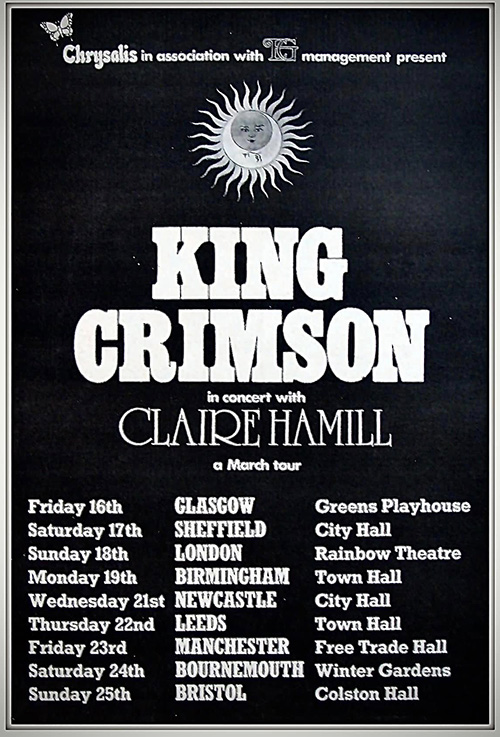
touring in good company
– “River song” that I quoted in the beginning was about water, the image permeating a lot of your writing and even driving the “Meeting Of The Waters” album. So what’s your relation with this element?
The river in question is the river Tees near where I was born – as the crow flies, about a hundred or two hundred yards. I was born in my grandparents’ house, and there was the road, and then beyond the road there was the railway track, and then there was the river, a very important one. And then I moved to be near the sea, and I spent most of my childhood on the North-East coast just north of Whitby, in a little village called Staithes. From the North East I moved to London, where I lived for some time, and then out to a village nearby, and I live by the sea again now. So water has a deep poetic sort of sense for me – water and the countryside are very, very important. Although I don’t go to the sea very often, it’s knowing it’s there that inspires me, At least three times a week I drive by and admire it, and love it, and feel grateful to live near the water. So, yeah, water is quite a theme.
Water is very beautiful and enveloping you – to me, it symbolizes cleansing and a feeling of home, although I know that the sea can be turbulent. In fact, one of my very favorite lines is in my song “Swans”: “We’re like swans on the mirrored surface of an English pond or the turbulent torrent of a swollen river” – I mean water can be this serene pool and it can represent turmoil, but I see it as something very comforting. When I live near water, I feel comfortable. “Swans” is one of my favorite songs, because swans mate for life, and it was inspired by two people I know that are a very devoted couple. I haven’t had the same peace and tranquility in my relationships for which I’m sure I’m as much to blame as anybody else, but they are a very solid couple and I wrote that song in their honor. Swans are beautiful, aren’t they?
– They are – but let’s get back to your early years. You were signed to Island Records – which is quite funny, given islands are areas of land surrounded by water.
Oh yeah, I never thought of that! Island… What a wonderful company! FREE were there – they were my favorite band; my friends and I absolutely loved FREE – and Cat Stevens as well, so to be signed to Island Records was a dream come true. It was unbelievable! I was over the moon, and I used to hang out at the office in Basing Street, above the recording studio – they had two studios, Studio One and Studio Two – so when I was in London, I used to stay at a hotel not far away, but I didn’t have anything to do. I didn’t know anyone, so I just used to go to the office and make tea for everyone, and scamper up and down the stairs in my black satin hot pants and my knee-length black boots, and my black polo neck jumper Gosh, I was jailbait! Oh, goodness me. (Laughs.)
– So it was important to you to be signed particularly to Island or you would have been happy to sign with whatever label there was?
I would have been happy to sign to whoever, but I’m awfully glad that was signed to Island because that was the perfect place for me to be. [Producer] Joe Boyd was like, “Well, who is this? I haven’t okayed her. I don’t know her!” – he was always a bit sniffy about me because he hadn’t discovered me and brought me to Island as he had with many of the other people that he discovered. But yeah, Island was the best home that I could have had, and I’m still in touch with some of the people that work there. I belong to Island Records Appreciation Group, and I saw Chris Blackwell about ten years ago, when there was a big Island bash and I was invited up to London to a party, and we both went, “Hello, how are you?” I loved him so much, he was great, just wonderful. I was so lucky, really was. I’m glad I didn’t sign with anybody else. Yeah, I’m really fortunate.
– You seem to have been given a lot of creative freedom there. You, again, were allowed to be yourself?
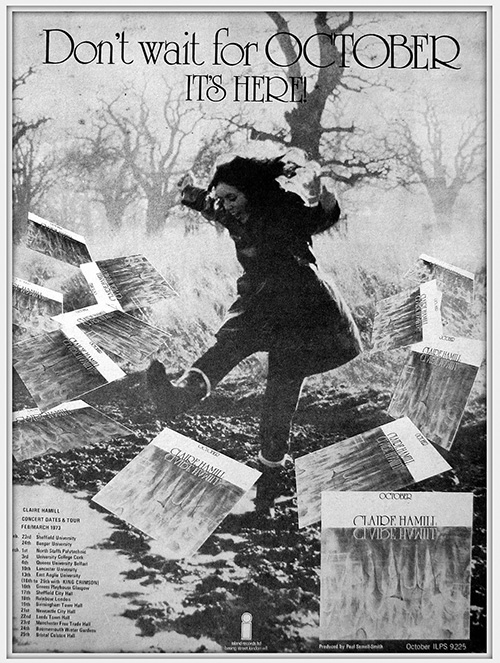
Yes, I was. It was only after my second album cost a lot of money that it changed. “One House Left Standing” wasn’t so expensive because it was recorded at the Island Studios with a lot of Island artists because Chris Blackwell brought them in for a favor and, probably, didn’t pay them very much. That was a cheaper album to make, but when it came to “October” we employed Paul Samwell-Smith, who just had a hit with Cat Stevens and Carly Simon, and he wanted to use the Manor, which was the brand new residential recording studios, a new concept – and he wanted to try it out. I was one of the first artists to record there, and it was expensive. So the album itself cost three times as much as the first one.
By the way, I knew Mike Oldfield when he was recording “Tubular Bells,” before he was discovered, because he was living at the Manor, when I recorded “October” there. He would go into the studio when the artists who were renting the Manor, i.e. myself and any other person that was recording there at the time, went to bed – and he worked for a few hours every night while we were all sleeping, in the downtime, as it’s called. But I remember I was there for three weeks, and he played me the tracks just before I left – and I couldn’t understand them! (Laughs.) I couldn’t because, of course, I wrote songs, and his were very much sort of instrumentals and a bit off-the-wall as well. So I went, “Very nice, Mike. Yes, very good!” And then, six months later, it was massive. Massive. And I had egg on my face then because I thought, “There’s no way this is going to be successful!” But I was proved wrong. He was a lovely guy. Very shy, actually. Shy and sweet.
Anyway, when “October’ didn’t tear up the charts and make lots of money, Chris wanted me to start making singles to see if I could have an impact on the charts and get some more notice. But by then I was a bit of a diva, and one of my managers at the time – I had two – wanted to work with Ray Davies, who was starting a label. So the manager said to me, “You should come to the Davies label, because there you will be able to make another album, whereas if you stay at Island, you’ll only be able to make singles!” – that was quite an arresting argument really. I really was into myself, I was very, very proud, and that wasn’t a good thing to be – I should have been more humble. I did leave Island at that point and went with Ray’s Konk. But Ray Davies, what a guy! He’s a genius and very charismatic, so it wasn’t a climb down in many ways. I was happy to go at the time, but it did mean I had to sign my publishing to Island for the next, I think, nineteen songs. That was not a problem – that was part of the deal for letting me go. Funny how life turns out.
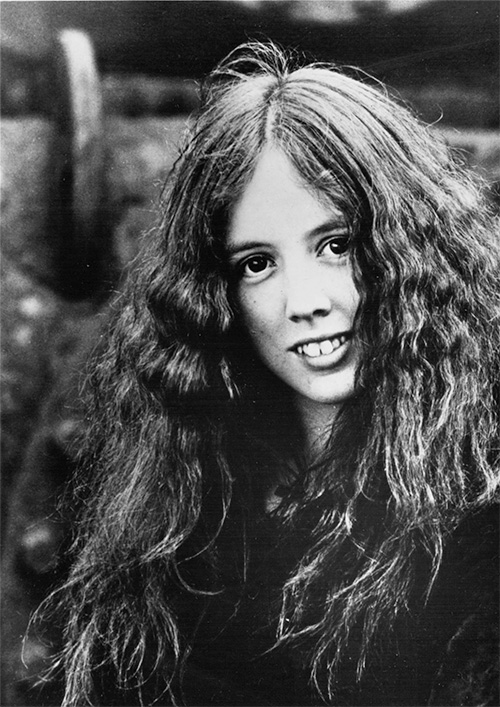
– You mentioned the feeling of home earlier, and there is an arc from “One House Left Standing” to “A House Among The Trees”: was it done deliberately or was it just a coincidence?
It was a deliberate thing done on behalf of the designer. CLAIRE HAMILL BAND is a project put together by myself and Sonny Flint, the drummer, whose wife [Christina Brandenburg] is a designer. She has designed the sleeve and she came up with the title, and I did say to her, “That’s so funny because it’s the opening line of my favorite song!” The favorite song that I’ve written is called “Trees” where the opening line is, “I have always wanted a house among the trees” – which also, as you say, arcs back to “One House Left Standing”… My pastoral life in the countryside after leaving London and having my children is huge for me – I did get a house among the trees! So when she came up with that title, it was like she plucked it out of my psyche, but it wasn’t my idea – it was hers. But I, of course, went along with it, so it worked really well.
– It’s interesting that you keep using the word “psyche” as opposed to “soul”: where do you draw the line between the two?
Your psyche is your thought part, the bit where your thoughts are created by the experiences you’ve had, and your soul is the part that connects you to God and to the rest of the human race, the mystical part of yourself that roots you to the earth. When I had my first child and she was pulled out of me, there was something inside of me at that moment that connected me right to the center of the earth. I’ve never known a feeling like it – and I think that’s your soul. Your soul is the good part of yourself, and your psyche is what happens to you and the things that you think of, and the way life takes you. Also, you can come to conclusions yourself about whether that’s good or bad, or what you think about it, your opinion, so your psyche is more about your experience, and your soul is very, very deep and inexplicable.
– How deep was your experience of life when you were recording your first album?
I was blown away! I was plucked out of school and came to London, and went into a big recording studio where I heard my voice coming back through speakers for… I won’t say it was the first time because I did do a recording at the art college, so I did hear my voice coming back through the tape that the sound engineer did. And it was that tape that got me my deal because we were able to play that to the boss of Island Records, who invited us then for a meeting. But sitting in a big professional studio and having my voice come back with a little bit of reverb on it – amazing! Absolutely amazing experience! I was transported then – it was mind-blowing! I had to pinch myself. But the funny thing about young people is that they quickly adapt because their experience of life is so narrow.
My childhood was rocky, so when this amazing thing happened to me, I just went, “You see, this is meant to be! This is what I was meant for!” You get this idea that the world has finally seen your greatness, and it’s all going to be plain sailing from now. You have this kind of cute naivety about the way everything is going to shape up. And I did get very big-headed because the music industry saw me as a bit of an anomaly at the time because I was young, I was precocious, I was talented and in a genre that had barely been created. I was very novel so I got a lot of attention, and I’d started feeling that I was too special. But I did have my sister back at home to tell me how awful I was! (Laughs.) Thank God for family!
– At that time in England nobody heard of Janice Ian, right?
No, I don’t think so. She came along a little bit later – probably, later in the same year or the year after. I know I was pre-Joan Armatrading, and I was definitely post-Joni Mitchell and Judy Collins, and post-Sandy Denny. But Sandy wasn’t a solo performer, she was part of a group, so it was a bit different for her. There was a girl singer called Leslie Duncan and there was Linda Lewis, who was different to me in that she was a little bit more pop-orientated. Being on Island Records really helped, because Island was seen as a label that signed serious artists, so that was extremely lucky for me.
– You mentioned Sandy. Did you ever meet her?
I only met her once, on the stairs, coming out of Chris Blackwell’s flat. Same with Joni Mitchell – I only met her in David Geffen’s office. We shook hands – “Oh, nice to meet you!” “I love your work!” – same with Sandy.
– Well, you shared the label with Sandy, but not with Joni.
But Joni l was the one I was able to identify with. As soon as I heard her and saw what she did, I went, “Ah, now I know what I do!” – because I had been writing songs already. There was Joan Baez, but she seemed to be so much older than me that I didn’t really identify with her. Also, she was very folky, whereas I was a little bit more contemporary than that. She was much more like Woody Guthrie and Bob Dylan, that sort of genre; she belonged to that sort of time in the music business and the people that she associated with; she was more of that sort of American thing. Joni Mitchell was different: she was fresher, newer, her songs had a life and a poetry that Joan Baez didn’t really have. But Joan Baez’s songs were much more accessible and folky and easy to sing. My mother loved to sing that one: (sings) “You walk through the town in a long black veil…” And of course, we loved Bob Dylan’s songs in my family.
– You covered Joni’s “Urge For Going” which she couldn’t have released it by then. Where did you hear this song?
It was played to me, I think, by David Lindley, who was in London at the time. He was friends with my manager, Tony Dimitriades, and Tony brought him in to work on my album. He would have known Joni Mitchell because of his association with Jackson Browne, so perhaps he was the one that suggested the song, but I did love it. I absolutely loved it. Terry Reid played guitar on it, though, which was interesting because Terry was also managed by Tony Dimitriades, and so he provided that lovely guitar, which was very different to John Martyn’s playing. John’s was picky and fluid, but Terry’s was like rocky and much more of an offbeat thing, which worked really, really well. And then, of course, you’ve got Simon Kirke on drums, which are very empty and atmospheric. So it made for a very good track – it’s always gone down well live whenever I’ve performed it live as well. I love that song.
The music business was really small in the early Seventies, really small: everybody more or less knew everyone else. The pop people tended to hang out so much, whereas the people that were involved in rock were very much everybody who was smoking pot, and if you wanted to smoke pot, you needed to be around other people, because it was something like a shared activity. It’s possibly how Tony and David Lindley met. David was an absolutely lovely chap, really nice. He once said to me, “Claire, whatever you do, don’t ever take any LSD!” I asked, “Why is that, David?” And he replied, “Because you don’t need it – you’re already crazy!” That’s a compliment. (Laughs.)
– So you saw yourself as a rock artist then?
Not exactly, no, I saw myself as a singer-songwriter, just like Joni Mitchell. I don’t think she was ever seen as a rock artist, and I saw myself absolutely firmly in that genre. As somebody that writes songs and sings them, not somebody who writes pop. As somebody that writes something more folky. But the thing is, I didn’t come from the folk background, so I never saw myself as a folk artist. That was why it was maybe a bit harder to sell me, because I didn’t fall into one of those genres: I never played in a folk club, and I wasn’t a rock singer. So I ended up very much going out on the road as just that – as somebody who sang and played the guitar. I sat down on a chair when I performed, I didn’t stand up, and it was very easy to put me on programs because there was only me. So I could go out with all of the Island bands: I supported HEADS, HANDS AND FEET and TRAFFIC once or twice, BRONCO, John Martyn, of course, and SNAFU, with Micky Moody and Colin Gibson. Those lads were from the north where I was from, and I’m still friends with Colin Gibson – he lives in my town, actually, he moved here before I did. It’s really funny when you move to a town and meet people that you’ve known since you were eighteen years old.
So it wasn’t easy to sell me, and I’ve remained fiercely independent of any kind of label, apart from, I suppose, folk rock: that’s the essence of what I do. But within that I like to go towards jazz sometimes, and a classical feeling too. I want the song to explore itself, I want to be working with people that hear the song and then hear something in it that they want to bring out of the song to help to create it. And I’ve been lucky to work with people that I’ve respected and have been on the same page with. I did experiment with dance music, because I met somebody who wanted to work with me and I was willing to explore that, even though I knew nothing about dance music. In actual fact, I don’t have the right voice it – I’m way too folky to sound any way clubby at all – but I was willing to experiment. And the album I did with Andrew Warren, called “Summer,” has got some very good songs on it. “One Day Left” is a great song: “We might have only one day left…”
– That’s your only double album.
Yes, it is. It’s my only double. Oh, well, apart from the compilations, but they’re compilations. “Summer” was a bit unusual in that it’s got some cover songs on it.
– When you had just come to London, you didn’t know anybody, so was it Blackwell who invited all those musicians to record “One House Left Standing” with you?
Yes – apart from Terry Reid and David Lindley and THE ALEX WELSH JAZZ BAND, all of the other musicians were brought in by Chris Blackwell, bless him. Thank you, Chris! He certainly gave me a wonderful start because they were all respected and they were all talented, and the album has stood the test of time. I still sell it. People still want to buy it because of the wonderful playing on it, and I’m very grateful to Chris for even giving me the opportunity to make it.
– What kind of producer was Chris – the one who dictated the sound or one who elicited the best performance out of an artist?
If you ask John McCoy – my other manager, who co-produced the record – Chris was mainly an absent producer.
– I assume that’s not the same John McCoy who was a bass player with GILLAN.
It was a different John McCoy. He’s from my area, from the North East. He was a club owner and a restaurateur, and a hotelier. John’s claim to fame was that he gave THE ROLLING STONES their first gig outside of London, in Teesside. His club was very famous in the area, and he used to put on all of the best bands, like MOTT THE HOOPLE. Terry Reid played there, when Alan White was his drummer, and I opened for their show. And it was Alan that brought his manager, Tony Dimitriades, into the fold and said, “She’s fantastic!” So Tony paired up with John McCoy. John also discovered Chris Rea from Middlesbrough and made him famous – Chris got in touch with him after John had signed me to Island. I knew Chris, everybody in Middlesbrough knew Chris, because his parents had an ice cream shop and a cafe where I used to go every Saturday. I fancied him. (Laughs.)
– Living in Middlesbrough, you must have known Paul Rodgers.
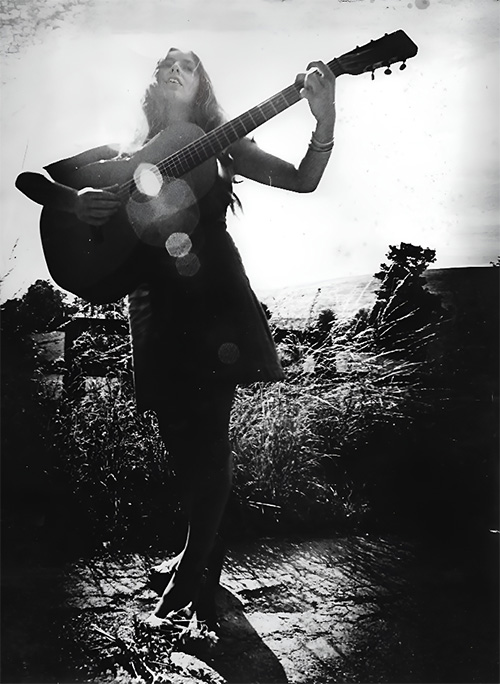
I didn’t know Paul at all. When FREE became famous, I was still too young to go out anywhere. I managed to sneak into the club that John McCoy owned underage because I had an older boyfriend, and the very first night that I was there, I walked up to John and asked, “Can I play here?” He looked down at me and said, “What are you doing in here? You look too young to be here!” (In a little girlish voice) “Oh, Mr. McCoy, I just want to play here!” And he said, “Do you play the guitar?” I went, “Yes, I do!” “And do you write songs?” “Yes, I do!” So he said, “Well, come on!” On Fridays, there was an equivalent of an open mic, where people sat around on beanbags, and I got up and sang some of my songs, and everybody loved it because it was unusual. So then John became interested and put me on a couple of support slots. Later he said that when I supported MOTT THE HOOPLE, I got on stage and told everybody to be quiet because they were making too much noise, and then I said, “Shush! I’m going to be famous one day!” – or something ridiculous like that. (Laughs.) I don’t know whether he made it up because it’s a good story. John McCoy, delightful man!
Both of my managers were absolutely wonderful! When I was recording my first album, John was there every single time, but Tony was busy. He was a music business lawyer, so he wasn’t at every session. Besides, it wasn’t Tony’s expertise, but John was a blues singer and a harmonica player, and he had his own band called THE CRAWDADDIES that had done some work for Chris Blackwell. Between them, they were a really good team, but mainly, John was in the studio and Chris would drop in and out when it suited him, because the studio was below the office. So he was around, but I wasn’t aware of his musical decisions. I think the thing was they just wanted to capture what I had, because they thought that was good enough.
– Still, they turned you electric and they even gave you Paul Buckmaster!
Absolutely. Paul Buckmaster, Arranger of the Year! How about that? There was this joke in the studio that when he was transposing, he was writing some music down on paper, and I just went, “Oh, how fantastic that is! Oh, that’s really clever!” And they were all laughing, because I had no idea how clever he was. But again, he was charming. Everybody was lovely – but the whole music business changed when the oil crisis happened in 1973. It was terrible. It was terrible because there just wasn’t the money. Prior to that time, they’d been investing in music, investing in people, taking a punt on this, and there was a great feeling of optimism.
But then the oil crisis happened, and I remember the change. Tony Dimitriades’s secretary, Carol, had worked at Apple, and she said Apple was lavish beyond dreams, it was almost like somebody was downstairs in the boiler room shoveling money into a boiler, and you can’t imagine that anymore. And you can’t imagine the music business when people would go out and have boozy lunches and come back to the office, like it was in the early Seventies. It was after the oil crisis, when vinyl got so expensive, that Island decided that they weren’t going to fund another album, and they wanted me to do singles because, as I mentioned earlier.
– By the way, how do you feel about the current resurgence of vinyl records?
I think it’s lovely. Vinyl is a very sensual thing, and I love the fact that people honor it and treasure it and want the resurgence of it. I don’t have any vinyl equipment, so I don’t listen to that, but I have got vinyl and I’m keeping it as well. I’m not getting rid of my vinyl because there may come a time when I can afford a top of the range Bose turntable. It is my dream to have the most amazing music setup at home and have a few friends round for lunch once a week, and then we’ll put on beautiful music and just drift into heaven listening to some of the world’s most amazing sound.
– Back to “One House”: with songs like “Baseball Blues” and “Smile Your Blues Away” that you wrote lyrics for, the album felt quite focused on America. Why?
I think growing up, all of the culture was coming from America. I was very influenced by the country-and-western films that we watched as children. John Wayne, Alan Ladd… I liked the culture where the good guys always won – I think that’s something that in our world at the moment we’ve lost. I blame Quentin Tarantino for that, who made the bad guys the star of the show. Doris Day, Rita Hayworth, Marilyn Monroe, all those wonderful female icons! America was a huge influence on the culture of this country, because our TV was in the early stages, and there wasn’t a great deal to draw on, whereas America was that much further ahead. So maybe culturally, I was a bit inspired by America, but then, of course, musically as well, although in the Sixties, we, in Great Britain, were the ones that were charging ahead with music.
“Baseball Blues” was just a sweet song about what we called baseball boots – I think they’re called Converse now. My boyfriend wanted to buy some new ones, and he just kept going on about it, so I wrote a little tongue-in-cheek song. I very much like playing with words and with ideas, and I’ve always had a genre of tongue-in-cheek little songs. One of the songs that I’ve recently released on the reissue of my first album is called “I Used To Be Famous” – which really takes the mickey out of being famous and then having everything stripped away and going to work in a cafe. But ultimately, the person in the song is grateful for being alive: you’ve got to see fame as it truly is – it’s a poisoned chalice, there’s no doubt about it.
As children, we want to be famous, me included, because I came from a very poor background, and all I wanted to do was get out of this place as THE ANIMALS sang, who were from the North East as well as I was. That was my landscape – even though I grew up in a very beautiful fishing village, when my parents’ marriage broke up, I moved back to the industrial wasteland where I’d been born, and it was very ugly wasteland at that time. Of course, it’s totally up my heartstrings now, and I will always be proud of it, because I don’t think you should ever decry your background. When you do come from somewhere that is tough, it does forge you in the fire a little bit. You can’t really have regrets about the tough life that you might have had, because it gives you great skills to be able to sustain whatever is coming down the road.
As for American influences coming in, I don’t suppose there are so many now, but there was a time in my life where I was taken away for the weekend by a musician called Ric Grech. He’d met Gram Parsons and Emmylou Harris, and he wanted to recreate that kind of combination, so he introduced me to country music, which I had no grasp of at all, apart from Jim Reeves. That Jim Reeves: (sings “He’ll Have To Go”) “Put your sweet lips a little closer to the phone…” Oh, what a beautiful song! I love the sentiment in country music that goes into a deep part of my being, but I wasn’t influenced by country music until the Seventies when I was introduced to it.
– There’s a story about you and Ric running up big expenses at a London hotel and charging it to Robert Stigwood who, as a result, dropped Grech from his management.
That’s true. We stayed in and we had supper there, with a few bottles of brandy, but Ric was a heroin addict – I didn’t know anything about heroin when I met him – so he went through three thousand pounds worth of my own money as well. I have every sympathy for Robert Stigwood, but I don’t think the bill was three thousand… It was a learning curve. I was only twenty-one, so it wasn’t like I was a fully formed woman, and he seduced me, like most of the men in my life. I’m very amenable to being seduced by a man! (Laughs.) That’s all part of being a woman, isn’t it? We were dropped partly because we weren’t making the music that Stigwood was interested in, but running up that large bill was stupid, and I went along with it because I can be stupid and go along with stupid things.
With the best will in the world, I suppose I’m a bit adventurous – I’m happy to see where the cards fall to a certain degree, because life is sometimes very interesting in that it doesn’t always go the way that you think it’s going to go, and I’m curious enough to see how it will play out. Robert Stigwood Organisation was playing on me and a little bit of fame that I had; they thought it was a punt, but we weren’t writing the kind of music that they were interested in. I remember being with Ric, though, when he wanted money, so we wrote a song together and he sold it for fifty pounds.
– Did you plan to record an album together?
We rehearsed, we did a handful of gigs, if that, but we never really recorded much at all, as far as I’m aware. Certainly, if we did, I’m not in possession of any of those recordings. As I mentioned, I knew nothing about country-and-western music, so Ric spent a whole weekend just playing me song after song and album after album until I could understand it – until I could understand why people liked it and what they saw in it. In fact, it’s remained a thread going through some of my own music, so I’ve got no regrets about that. Ric and I, we were only working together for a short period of time – after I’d run out of money, it was time for him to move on. I ended up moving to London and finding somewhere to live, and he occasionally came over to visit me.
I had this beautiful silver fox collar that a friend of mine had given me, and Ric asked me if he could borrow it to put on his coat, because he was going to a wedding. He had a very long, manly tweed coat that he put this collar on, which made it look very rock star – but about a month later I bumped into somebody who he’d sold the coat to, with my silver fox. I couldn’t believe it! Addiction is a terrible thing – it robs you of any sense of yourself, of what’s right and what’s wrong – you’re just taken by it. I did take some heroin while I was with Ric, but it never did anything for me. I found it very uninspiring, because I’ve always associated drugs with pain. Some drugs are recreational, they make you feel better about yourself, but heroin is a numbing one – it numbs your pain. I think that Ric was in pain, and he needed that to numb it. Ultimately, I felt very sorry for Ric, but I didn’t stay around him once I realized how deep his problems were, because you can’t have a life with somebody like that. That level of addiction is just way too deep If you’re willing to sell things that belong to other people.
– How did it feel to be face-to-face with America on the Concerts 10 festival? There were hundreds of thousands of people, right? Was it intimidating?
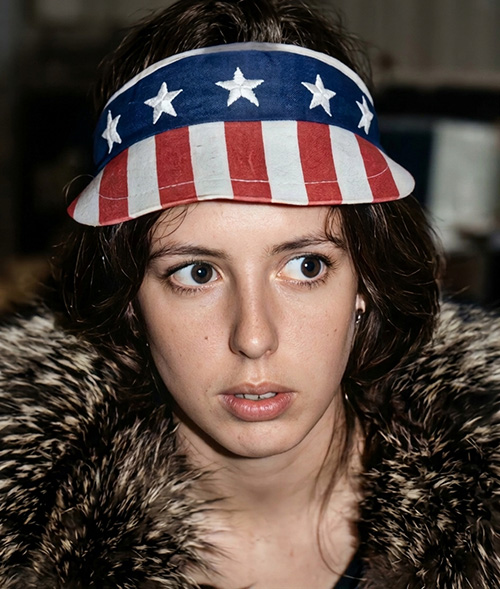
There were two hundred thousands at the Pocono festival, just outside New York. Two hundred thousands! We were flown in by helicopter – that was my first time in one – which was really exciting. But the terrible thing that I did – and it just shows you what a little diva I was – was that I left my manager behind at the hotel and I took my boyfriend with me. To this day, I’m still friends with my old manager, and he later said to me, “You really made a mistake there. I should have been there, backstage, talking to all these people. I could have been doing deals for you!” But I was so in love, and I suppose I was showing off to my boyfriend – he’d never been in a helicopter either. Oh my goodness, the stupid things I’ve done in my life! Honestly, there’s loads of them. When I get around to writing a book, I’m sure people reading about them will go, “Why on earth did she do that?” I asked myself the same questions, but hey, it’s been fun, and I’ve got no regrets. I live with what I’ve done. It’s interesting, the twists and turns of your life, yeah.
Singing in front of those two hundred thousand people, I won’t say it wasn’t intimidating, but I’ve always wanted to give. I remember once having hypnotherapy… I’d been off the road for ten years, and I came to live down here in Hastings, which is a bit of a backwater, with my young children. And I met somebody, another musician, who encouraged me to play locally. I’d left the music business at a high level where I was playing theatres, and then I was being offered gigs in pubs because the milieu, the general public had almost forgotten me. I remember doing a gig, where people were talking during my performance, and I was so upset that I couldn’t accept any work. So I had to have hypnotherapy, and the hypnotherapist said, “The thing is that when you sing, it’s not about getting back from people – you are the one that gives. There will be people in the audience that will want what you’ve got to give, and there’ll be other people that don’t, certainly if you’re in a pub. You’re going to have to ignore those people and concentrate on the ones that are interested in you”: it was really good advice. From then on, I’ve always thought that it’s a privilege to be on a stage, to perform for people, in this very full pool.
Back in the day, when I was doing it, there weren’t so many artists like me, so I stood out and I was given the opportunity to sing in front of two hundred thousand people at a festival. It’s remarkable now, when I look at the copies of “Melody Maker” and “NME” or the posters of those days, that you won’t see a woman there – there won’t be a single woman’s name – so it’s quite astonishing how we’ve moved on. Which is great, because women have got voices that need to be heard. So yeah, it was scary, but I’d always had a childlike love of it, wanting it and just having an adventure.
– Was there any cultural shock when you went to America?
Oh, very much so! Very much so. I remember the very first dating show that I ever saw was in America, in 1972: I called it “The Divorce Show” because it seemed like the questions they were asking people about each other were revealing things that they had no idea that that person felt. Later, we had “Blind Dates” and things like that, which are very popular now, but that was the first time I’d seen it. Oh, and the other thing I remember, when I went to North Carolina, was seeing daytime television that was all about Bible thumpers, all about people saying, “This is the word of the Lord!” What I remember is them saying, “Send me your money, and the Lord will reward you!” And I thought, “Oh my God, these people don’t really believe that that’s what it’s all about, that they will send some money to this man, and then they will somehow be rewarded!” Of course, a few years later, it turns out that these people were frauds, and that was a real eye-opener. But the Americans absolutely loved them. Still, I think America is an amazing country, and everybody should go there at least once in their lifetime. I loved it. I still do.
I love the whole world. Everybody’s beautiful and kind, and it’s the politicians that ruin it. The other day, when they were talking about our new government, what we were going to pay for, and how much money we were going to spend because we have to defend ourselves against our enemies, I turned around and went, “Why have we got enemies in this day and age? Are we not paying diplomats to go out and be friends with everybody?” I can’t believe that all these people that are running their countries are turning around and saying, “You are my enemy!” Why? It just beats me. It just beats me when we need that money on solar energy, water, forests, food, shelter, education. It beats me, because how many years is it since the second World War? How far have we come? Have we not come anywhere? I said, “Before they go into a political meeting, make sure they all take some ecstasy pills so they can all grab each other say, ‘Oh Zelensky, I’m really sorry I bombed you!’ ‘Oh, I know, Putin, I’m sorry I bombed you as well. That was such a mistake’. Come on, guys. Come on! What’s wrong with you?”
The AI won’t let this happen anymore, it won’t. AI is just going to say, “No, no, war does not make sense. All you people have got shares in armaments and everything, when you can have shares in washing machines now or cars, or satellites, or universities!” Everybody knows that’s the trouble – we all know it’s all been badly run. We thought we can’t do a damn thing about it, can we? Not really. Not yet. Anyway, not until all the AI says, “You’re all idiots! You’re all sacked! We’ve got to spend the money on something else!”
– Talking about strange things, there is one song that stands out for me on your first album, “Flowers For Grandma”: it’s a very strange story, but what made it special for me was that you were said to have played a pipe organ on it.
Oh no, that wasn’t me. At least, I don’t remember. I did play keyboards in my earlier life, and I had a keyboard at home. And I famously lent my first electric piano to Chris Rea, when he asked me to borrow it, and he never gave it back. But I don’t remember playing pipe organ. I thought it was John Hawken – it might’ve been him because he did that little at the end of it (trills a passage), and I don’t think I would have thought of doing that. It was a cute little song, and my eldest daughter liked to sing it, but she changed the tune, which used to drive me crazy: she didn’t arrange it the way that I did, she didn’t sing it the way that I did, and it used to annoy me, but I was so glad that she’d sung any of my songs. Again, I like those songs that are not within your genre, that can wake people up if they’re listening to an album and they’ve been lulled along – then, all of a sudden, you’ve got an odd little song in there. One of my albums [“When Daylight Arrives”] has got a song called “Vegetables” on it, which is all about living on vegetables because everything’s so expensive: it’s kind of a throwaway song, but some people love it and think it’s great.
– Even on your last album you followed “Snakeskin Lover” with “The Werewolf And The Maiden”: it’s this switch from Latin rhythms to English folk that made this couple of songs the best place on the album.
They are two of my absolute favorites. Yeah, I’ve always wanted to explore music and, weirdly enough, I think the song itself asks you for its treatment. My favorite rhythm of all is samba. I love samba rhythms! My brother is a samba DJ – he lives in Colombia now, and he brought that kind of sound over to this town when he visited South America. But I’ve always liked it. My mother loved to do the cha-cha-cha – she had a great sense of rhythm. So I’ve always loved that South American beat and I’ve always included that in my repertoire of the songs that I’ve written through my life. “Snakeskin Lover”: I absolutely love that song, it’s so nice to do live. It’s again, a bit tongue-in-cheek, a little bit bolshie, but it’s got a great rhythm, so it goes down very well with people. And then, “The Werewolf” has a completely different feel to it.
In the first one you’ve got the woman who’s on top, who’s seen her Snakeskin Lover for what he truly is, and you can see that she adopted a lot of his style with the men in her life and treated them like nothing, but she sort of swaps around in the end, redeems herself, quietens down her life and goes into a bit more of a reality check. But “Werewolf” is very much about a tender girl that is overwhelmed by the werewolf and she becomes his victim, so it’s a lot more serious. A great song too, and I love doing it live as well. We don’t do “Your Name Is In The Wind” live, though: that’s a little bit too orchestral for a rock band to get their head around. But maybe one day… I love the latest album – it’s got so many good songs on it. I’m very proud of it.
– Is there any of your albums that doesn’t have very good songs on it?
No, I love all of them, because they’re all a part of my life, although some of them are maybe unconventional a bit.
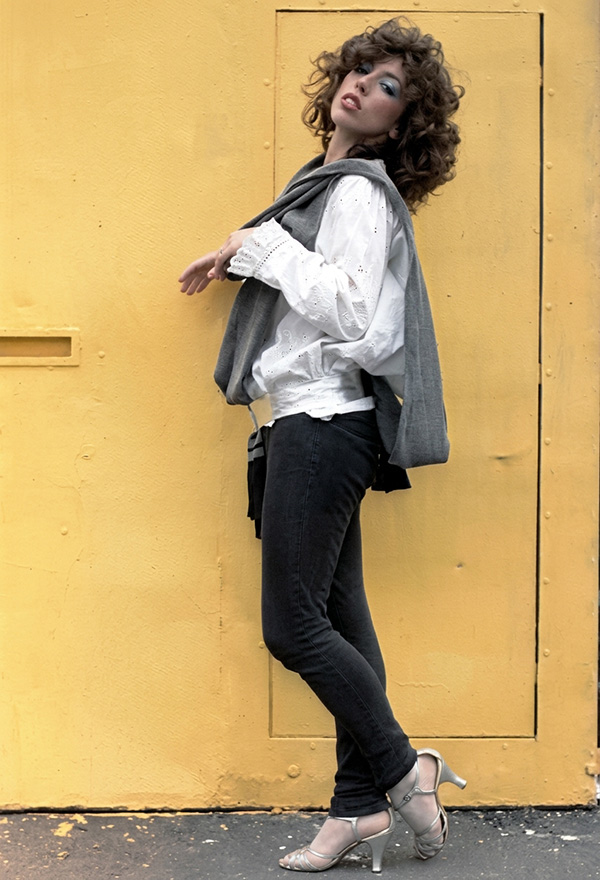
– But that’s the pleasure of running through your works: one never knows what to expect from you, unlike, say, from Paul McCartney. Like we were talking about “Baseball Blues” which wasn’t a blues at all, and then, very unexpectedly, you had Jimmy Reed’s “Baby What’s Wrong (With You)” on “October” – a real blues!
It is a blues! It was suggested by Paul Samwell-Smith, the producer. I’d brought all of those songs and they were all good, but he said, “No, we need one more song to fill out the album, and I think you should do a blues!” And of course, it was successful. I didn’t know I was going to scream at the end – I just went with it, it was very much unplanned. I loved working with the musicians and bringing out that side of me, which I hadn’t been aware of till then – that sort of more cheeky, slightly sexy side – because up until that point I’d been just exploring a gentle, romantic side of my music. When that song hits, it is a different flavor. I’ve never done anything like that before. So, yeah, a good choice.
– How was it – working with Paul?
Oh, wonderful. He was a very serious producer. To this day, “October” is one of the best-sounding albums I’ve ever made, and the clarity of the sound was down to his meticulous approach to recording. It was a very interesting experience, very disciplined. SMITH-PERKINS-SMITH had just been signed by Island Records, and they were over in England at the time promoting their record, so So Wayne Perkins very kindly came and played some guitar. Brilliant player! But it was so cold, because we recorded it in the autumn. The Manor itself, where everybody stayed, was a beautiful house, but the studio was a barn and the control room was in the hayloft, so you had to get up a rickety staircase to go there, where all the equipment was.
We were recording down below, and it was freezing, so Wayne took his lighter out of his pocket and ran the flames over his fingers to warm them up so he could do his solo. I’ll never forget that! (Laughs.) Dear Wayne. He only just recently died, didn’t he? Bless him. Really interesting person, but very shy and a bit troubled. You never know with people, do you? But he was lovely, absolutely lovely. We also had Jean Roussel on keyboards. Paul had just worked on a Cat Stevens album with him, and Jean was immensely talented. So fantastic. I was really lucky to have those people on the album. Paul brought them in, so yeah, it was great working with Paul, even though it was expensive.
– I don’t know why but “October” sounds like a heartbreak album to me. What was happening in your life at the time?
I’d fallen in love with my Warrior of the Water, a young American. I was friends with Alan White from YES, and their producer was Eddie Offord, who lived in London and whose girlfriend at the time was an American from North Carolina, so I knew her. And she once said, “If you ever come to America, look me up. I’m going back there for the summer. Come down and visit me!” And when I had a break in touring, I went to North Carolina. It’s really funny, because I was only seventeen, and my manager had to write a letter for the police, if I was ever stopped, saying that he knew who I was and what I was doing, because I was going over county lines and I was underage. So I went down to visit her, and she introduced me to Mike Marsh from “Marsh’s Surf and Sea” shop. I remember her saying to me, “Hands off him! I like him. You must not go near him, because I really fancy him!” But I remember the first time we went back to his apartment – he’d just been out surfing, and he came out of the shower with a towel wrapped around him, this bronze, green-eyed Adonis, and I went, “Oh my god, he’s gorgeous!”
Of course, me being English, I was very exotic – because I was a songwriter and played the guitar, and I could sing that made me doubly exotic – sо we both fell madly in love, and when I came back to England I was heartbroken to leave him. Therefore, a lot of the songs reflected that, especially “Warrior Of The Water” which was particularly his. The other song I wrote for him was “You Take My Breath Away” which became a very lucky song for me because Eva Cassidy recorded it. But we couldn’t be together, and it was tragic. I loved him so much, but I had six younger brothers and sisters, and being the eldest girl, I occupied an important place in my family, so the idea of leaving them all and going to live in America… Well, it just wasn’t on. So eventually, he met somebody else and married them. Yeah, it’s one of those stories.
– You also wrote a song about Alan White. What was the song?
It was called “All The Cakes She Baked Him”: (recites the lyrics) ” Always friends but never lovers, though their bedrooms were together many times… ” I shared a flat with Alan and oh, I loved him! Loved him – who couldn’t love Alan? What a talent and what a gorgeous man! I loved him so much, but he had a girlfriend, and I loved her too. She’s still my best friend, Rory. Before she came along, I was secretly in love with him, but we both were young – he was five years older than me, and I put him on a pedestal. Now that I look back, there were moments when possibly we could have got together, but I think each of us was waiting for the other person to make the first move, and it never really happened. Alan went on to have a happy life with Gigi and have some children, but when he was with Rory he used to go away on tour – I think YES did a massive tour of America and South America, and he was away for six months – and I remember thinking that I never wanted to marry a musician, because if that was going to be my life, that wasn’t going to work for me. When I fell in love with somebody, I just wanted somebody that was around me – I don’t know if I’m still like that now, because I haven’t got anybody in my life. I’m not quite sure how I am anymore with the men now, but at the time I was a little bit needy.
If you look back, if you want to psychoanalyze yourself, probably not having my father around has been a huge influence on my development as a person. It’s the tragedy that we have now many generations of people that have grown up without father, because it became normalized in the Seventies – it was changing in the Sixties, but there was still very much this atmosphere or respectability about relationships and staying together, but of course, when you had the contraceptive pill coming in it meant that men didn’t have to be tied to the children that they might create, because they could have sex with women that weren’t going to create children. That was a huge change in society, and we are seeing the ramifications of that now: the disenfranchisement of young men and young women. I grew up without my father after the age of twelve, and that was a profound change in my life that I didn’t have that protector, so I became a bit adventurous. We are what we are, and I had a wonderful time, but I was probably more promiscuous than I might have been if I’d had a father around – but who knows? I’ll never know the truth, but that’s something that I could suppose, maybe there is this current going through my music that is searching for that man..
I started writing a song many years ago: “I’m looking for my father, and I see him in every man, and that’s what scares me” – that was the opening line, but I’ve never finished it, because I don’t want to put that out there. Yes, you want to examine yourself through your work, but you don’t necessarily want to be too down all the time. As you said earlier, there was heartbreak going through “October,” and I will always put myself in my songs because that gives meaning to them, but as an artist, you have a duty to uplift people, and that’s why I love to write my throwaway funny songs. I’ve got one about going to sleep, and in your dreams you sing like Barbra Streisand: that’s one of my funny songs that I love I love to perform when I’m doing solo work. I don’t want to be an artist that takes themselves too seriously – their life is very serious, and I’m happy to write my serious songs, my war songs and things like that, but I also want people to go away with a smile.
– Apart from Alan, you had Gerry Conway on “October” – and his FOTHERINGAY colleague Pat Donaldson, too,
Yeah, they were brought in by Paul because they’d worked on the Cat Stevens album. Lovely guys! I became quite friendly with Gerry’s girlfriend, the Honourable Tessa – her father was a judge or something like that. She was a real character! She drove a Harley Davidson. In the summertime – I was on the back, so I remember this – she had a crash helmet that was covered in swan’s feathers, and when it was winter, she drove it in a fur coat with a crash helmet with a fur hat on the top! I really liked her. The trouble is, you meet people and you have a great time with them, and you really connect, but life moves on relentlessly, and you just can’t keep hold of every great person that you’ve met. She was a wonderful person, very different, who lived life on her terms. I like people like that.
– Around that time you toured with KING CRIMSON. How do you remember them?
They, again, were part of the Island family,so it made sense for me to go out as a support act. Because I was solo, it was easy, because they only had to set up to two mics at the time: one on the guitar and the other on the vocal. Also, for the Island agency it was two birds with one stone: they were being able to promote me, and the main act could have continuity by putting me on the tour. Robert [Fripp] and I hit it off – he took a shine to me, and I thought he was a fantastic musician and another one-off individual that lived life on his terms. We developed a very close friendship – we were lovers, actually, for a while – but the problem was that I was still in love with Mike Marsh, and even though Robert and I had this really great relationship, I couldn’t forget Michael, so it didn’t develop very far.
And the other thing was that Robert never wanted any children, and I could never consider moving forward with somebody who didn’t want children. But we had a good time together, and I look back on it very fondly. He was the inspiration behind the song “Love In The Afternoon” – he actually wrote it with me. I went round to his house one day in Dorset, stayed the weekend with him and he said, “Let’s write a song!” I asked, “OK, but how are we going to write it?” And he went, “We’ll just start playing something or just start singing something!” So I started singing whatever tune it was, and he started playing the guitar underneath it, and eventually I wrote the song that became “Love In The Afternoon”!
– I don’t think he’s credited for co-writing it.
Is he not? I’ve never denied that he wrote it with me, and if it got missed off the credits, then that’s terrible. But he’s definitely credited at the PRS. It should be “Hamill / Fripp”! I’d love to tell the world that Robert and I wrote a song together!
– What are your memories of the other guys in the band?
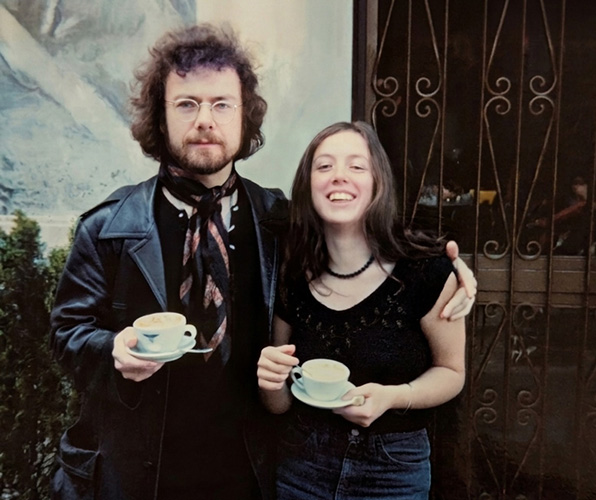
John Wetton and Bill Bruford! It was quite funny because, when I toured with them, we did this Italian tour, which was incredible, because all of the guards had guns, which I’d never seen in Europe before. John Wetton was adorable, he was a very handsome young man, and I remember going to a nightclub after one of the gigs in Rome or Milan, and there was this beautiful blonde girl hovering nearby, so I tried to get them together. I was being a little matchmaker saying, “Oh, this is John. He’s a famous musician!” John and I, our lives connected because he dated my flatmate, Jill Briggs, and I saw a fair bit of him then. And of course, Bill Bruford had left YES to join KING CRIMSON, and Alan took his place.
I’ll never forget the day Alan got his gig with YES: we were all celebrating because we knew they were a massive band – they were heading for the top stadiums, so Alan went out and bought a white Rolls Royce We were all sharing a flat – my manager had a mews flat in Marble Arch, so Alan and Rory lived there, and Tony and I lived in the box room, where I was sleeping – and we all went into the courtyard, when Alan pulled up with his new car. “Cheerio! You’ve made it, Alan! You’re in a band that’s going to make some money at last!” And, of course, he went on to make a massive amount of money with YES and bought many fancy cars. (Laughs.)
He’d sold the white Rolls Royce, and he’d bought a green Bentley Flying Spur, which was absolutely beautiful, an aubergine Panther sports car, and a white Range Rover. One day we were all sitting around in the flat, and Rory went, (imitates her voice) “Alan, which car can I have today?” He said, “Well, you’re not having the Range Rover, I’m driving that to rehearsal!” She asked, “OK, can I have the Bentley?” And I went, “Yeah, yeah, the Bentley, the Bentley!” He just looked at me and her, knowing that we were going to go out in the town in his fancy car, and went, “No, no, no, not the Bentley!” So she said, “Can I have the Panther, then?” And I was like, “Yeah, yeah, the Panther, the Panther!” And this poor man, seeing these two women going out swatting around the town in his beautiful car – it absolutely drove him crazy.
I shared a flat with Alan and Rory for a number of years – I was their sort of little sidekick. Rory didn’t like to cook – she was a model, so she hated food, which was like an enemy: “I’ve got to stay slender all my life!” – so I was quite happy to do it, because I wanted to learn how to cook. So they would buy the food, and I would cook it for them. But when Alan had joined YES, who were all on the kind of a vegetarian road. he had to become a vegetarian too, so Rory said to me, “Right, I want you to make a shepherd’s pie with meat on one side and soya mince on the other, covered in potato, and with pastry underneath… I went, “Pastry? You don’t have any pastry in shepherd’s pie!” And she replied, “Well, I want pastry!” So I made this really weird pie – mad, absolutely mad!
– Is it the same Rory you dedicated a song on “Abracadabra” to?
Yes, the same one. She was like my big sister: she’s seven years older than me, and she’s tall. Californian, famous father, grew up in Hollywood – she was everything that I was not. I was a short, plump girl from the North East of England, grew up in a very poor Irish Catholic background. I just looked at her and said, “Oh, my goodness, me! She’s so elegant, she’s so wealthy, she’s so exotic!” And because she was so tall and I was so short, and I was a bit famous and she was a bit famous, we realised that we were standing out amongst other people, that we were a bit of an anomaly, so we just hit it off. And we have stayed close ever since. She’s adorable, but she does tell me off. She says, “Oh, my God, Claire, what did you do that for?” She turns up once a year to sort my life out for me.
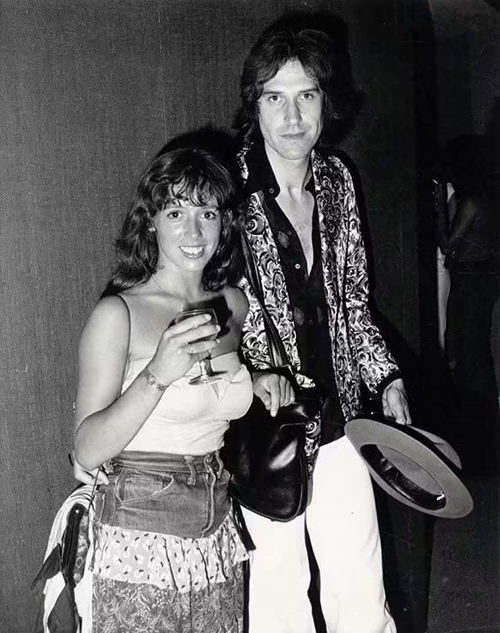
– You went disco on that song.
Boom, boom, boom, boom, boom, boom, boom, boom. Yes, it is more disco from the point of view that it’s more light and rhythmic, rather than being more folky. The trouble with the song was that one of the lines is “She’s a lover and she’s a lady, and I love her back, of course…” I remember being on tour at the time and playing it, and – this is no word of a lie! – the chap that was looking after me from the Konk record label, John Darnley, said, “Everybody thinks you’re gay because of that line!” I went, “What?” “Yeah, there’s a rumor going around that you’re gay…” I said, “Don’t be daft!” He replied, “Well, you haven’t pulled anybody on tour, have you?” And I went, “Well, no…” So he said, “The sound man fancies you.” And I just said, “Oh, you’ve got to be joking! But go on, send him in!” I had to sleep with somebody on the tour to prove I wasn’t gay, which wasn’t a problem. I loved it. I love sex and love men. But I thought it was really funny.
What I meant was, she’s a lover of the world, she loves everything, she’s in love with life – and I didn’t mean she wasn’t my lover, far from it. Going to Ireland with her, which I have for many years, she is a proper flirt, and I realized that, whenever we would go out to a bar or anything, she’d say to people, because everybody sings there, “Oh, this is my friend. She sings. Would you like her to sing a song?” So I’d be there, singing for my supper, and she’d stand at the bar with all the men going, “Yeah, that’s my friend. Isn’t she cute?” She did that so she’d get all the attention while I was singing away. (Laughs.) She taught me how to flirt, that’s for sure.
– You even became a bit provocative on songs like “Low Key Prostitution” and “Sex With A Stranger”!
I was thinking about “Sex With A Stranger”the other day: it’s a tragic song, really. Hormonally, we are driven to have sex. Luckily, when you get older, it quietens down a bit, which is a good idea, to be perfectly honest, because you find you don’t get into so much trouble anymore. (Laughs.) The song is about not wanting to have sex with that person that you deeply, deeply love, because you know that there’s no future in it and it’s going to wound you every single time, even more when they leave you.
And “Low Key Prostitution” was inspired by the fact that there are high-class prostitutes out there, the most beautiful women who get booked to fly to Dubai and get twenty grand. If you’re beautiful and you don’t have any great education or you’re not brainy or anything, why not use your looks to get on? Let’s face it: it’s not going to be there forever. When they stopped those girls walking around the wrestling ring or the boxing ring, that was tragic – that girl had a good job. Stop doing just because she doesn’t feel exploited – she’s getting paid for walking around in a swimsuit to look beautiful. What’s wrong with that? It’s not fair. The same in Formula One, where the lovely girls would be hanging out with the drivers. I understand how that might lead you into something that’s not right.
Don’t get me wrong: I don’t think prostitution is right. But I think being beautiful is good and there’s nothing wrong with using that, and the protagonist in the song sees it: she knows and she understands that she’s being used, but she’s also using them and she’s out – she’s leaving at some stage, she realizes this is not the life for her. So there is a kind of a moral story behind it, and it’s also tragic. I found that story about the woman on OnlyFans that was going to sleep with a thousand men, and that’s just awful, because her parents were all behind it, controlling her bank account. That’s the worst thing of all, to feel completely exploited by her own family – and there have been other mothers in history that would have done that with their daughters. It’s a terrible betrayal, because you want your parents to protect you, not exploit you.
– How did your family react when they saw you around that time, in the early Seventies, on “The Old Grey Whistle Test”?
It was mind-blowing for my family, absolutely mind-blowing. I was living in a small industrial village between the gasworks and the shipyard, and the people that were mainly living there were very working-class and salt-of-the-earth people. I suppose my family were a little bit different, because we we were all quite educated and aspirational – but still, to be on national television and in a serious way was a crazy thing to do and to be part of. It wasn’t just a talent show or something – it was “The Old Grey Whistle Test”! So it was alienating, in a sense, but there was also a lot of pride there. And my family were also proud of me because they didn’t see so much of me anymore after I was whisked off to London. And of course, I wanted to whisk myself off: I’d had a childhood where a lot of responsibility for my younger brothers and sisters had been put on my shoulders because my mother was quite ill after my father had left, and I had to be the eldest girl. Leaving my family and going to London where I was the baby was almost like having another childhood, and it felt quite nice. But it was lonely, because I came from a big family and I had always been surrounded by people, and now I was on my own in a hotel room. But it was still incredible.
– And how did you feel watching yourself on screen?
It’s a feeling that you can’t forget. But weirdly enough, because I was performing live, I don’t think I did see myself on TV – I must have seen the performance afterwards. Being on live television, which is when you’re playing and they tell you that thirteen million people are watching this, it was scary. You’re singing and at the same time thinking, “I’m going to throw up. I know I’m going to throw up!” – but actually it was fine. I didn’t. (Laughs.) That was a really good thing to do.
– While we’re on the subject of screen… You mentioned a song called “I Used To Be Famous” where you describe your encounter with Franco Zeffirelli. Did you really meet the maestro?
“Franco Zeffirelli asked me to dance…” I picked his name out of the ether, because it went really well in the song. There are some elements of it which are definitely biographical, like Hampstead where Alan and Rory had a flat, but the funny connection is that, when my dear friend Rosie Potter heard the song, she said, “I don’t believe you that you’ve mentioned Franco Zeffirelli!” I asked why and she explained, “He stopped and picked me and my girlfriend Sandra when we were hitchhiking, and I’ve actually got a photograph of us with him!” So I met him only by prox, but I’ve always loved his name. It’s such a romantic name! But “I Used To Be Famous” is a good little song in a sense that you’ve got to see yourself as an imposter. When I was young, I equated fame with success, and success has got lots of different faces, but fame is not one of them. Fame robs you of so much! There’s certain trappings of success that come with fame, but on its own fame means nothing. I can walk down the street in my town, go shopping and be a normal person, and that’s very, very valuable There are times when I do feel a bit observed in my own little neck of the woods, because people notice you and they’re curious about you, so I have felt lately that it was time to move somewhere more private.
– You also opened for THE KINKS, right? Was that before you joined Ray Davies’s Konk?
I only remember doing one gig with them, which was on the Hastings pier, but I don’t remember having anything to do with them before I joined Ray’s label.
– When you joined it, whose idea it was to give you so many covers to do on “Stage Door Johnnies”?
As I mentioned, John McCoy thought there wasn’t a marketplace for my songs, so when I when I went over to Konk, the idea was to do some covers, and that became “Stage Door Johnnies” – which is a good album, but I wouldn’t have chosen to do so many covers.
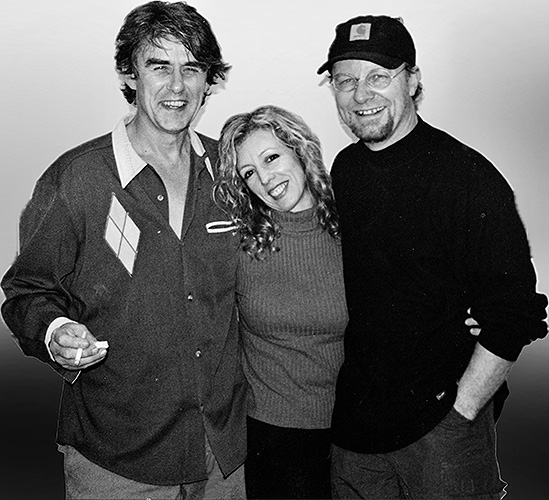
– On “We Gotta Get Out Of This Place” and “Oh Daddy” you seemed to demonstrate a different vocal approach, right?
“Oh Daddy” came because I put my toe in the water with that twelve-bar blues on “October” – and because John McCoy suggested that I did the Bessie Smith song, which I loved. I’d been introduced to blues years before: my mother had a boyfriend called Vic Felgate, and he was the first person that ever played it Joni Mitchell to me, and though he played guitar and he and my mother used to go out to folk clubs, he was very interested in blues too. So I did listen to a lot of blues that he had in his collection, and I love Bessie Smith, so I was pleased to do “Oh Daddy” which I thought was a really good song.
Again, I’ve been lucky that people introduced different genres to me, and I’ve also wanted to experiment myself in certain ways. For instance, when I made my new-age album, that was my ex-husband’s suggestion. He [Nick Austin] discovered this music at a conference in America, so he started a label within the Beggars Banquet umbrella, which was more instrumental-based, and he wanted a way of trying to sell it. He said to me, “I want you to sing it – no lyrics, no songs, just sing the whole album!” I went, “Are you joking? What a crazy idea! I’m a songwriter!” But he replied, “No, just go into the studio and use your voice. Layer it up, do experiment with it!” And that became just about my most successful album! But that wasn’t my idea, that was his idea.
And when I did “Oh Daddy” and “We Gotta Get Out Of This Place” before that, I was going more into a rock direction because I was touring with rock musicians. I was surrounded by rock musicians, so they very much were influencing me. If I, perhaps, had been living with some folk musicians and touring with folky people or people that were involved in jazz, I might’ve gone down that route. But I was influenced by the rock musicians that I was listening to at the time, and I remember hearing Pat Benatar – I’m not quite sure when she became famous; I think it was after “Stage Door Johnnies” but before “Abracadabra” [actually, after “Abracadabra” – DME] – and thinking, “Wow, what a fantastic singer!” I wanted to be like her, but I couldn’t. I proved to myself during my stint with WISHBONE ASH that I wasn’t a rock singer and my voice just couldn’t stand up to it. It’s stronger now, now that I’m older, it’s got a stronger timbre, but I’ll always want to make a beautiful sound rather than a tough sound, if you know what I mean.
– The new-age album you talked about, “Voices”: it somehow reminded me of Sally Oldfield. Did you ever listen to her?
Not really, no. I’m not somebody that listens to a lot of other people. I’ve always been terrified of plagiarizing anybody, so I’ve tended not to listen to other people. I know it’s shameful, but it was safe to listen to any of the rock people that I was surrounded with, and I was surrounded with music, so I didn’t feel the need to explore anybody else’s work. Alan and Rory had an extensive record collection, and I tended to listen to what they were listening to, but I didn’t spend a lot of money on buying any records. I got given records, though, and when I did an interview for “Record Collector” and they asked me which was the first record that I bought, do you know what I said? I said it was “Kiss From A Rose” by Seal, from the early Nineties! (Laughs.) I went through all that time without really buying any records or listening particularly to anybody.
I was aware of Sally Oldfield, but it was more like a background thing that she worked with Mike, so I didn’t listen to her. But I heard… not Enya, she came after me, but the vocal arrangements of [Holst’s] “Planets” that was similar to that layering of voices. But that was different, because that was like a band thing and they were songs. So I crafted the idea for “Voices” before I went into the studio, and I mapped out what I was going to do vocally, and I’ll never forget the sound engineer saying, “This is amazing!” I went, “Don’t be silly! It’s not, it’s not! It’s got no words!” And he said, “No, honestly, this is amazing!” It was groundbreaking, and I’ve always wanted to do another one, but I never have because I love words, you see. I couldn’t wait to get back into writing words again. So when [next album] “Love In The Afternoon” came out, it was a little bit of instrumental and a little bit of proper songs, and I tried to mesh both of them together.
– It was on “Stage Door Johnnies” that you recorded “You Take My Breath Away” which Eva Cassidy would cover much later. Do you think her version brought you a bit more of fame and appreciation as a songwriter?
That was a fantastic moment in my life, because I had never had anybody record any of my songs. I’d always wanted people to hear my songs and want to record them, but they lack a certain pop grabability – they’re not sing-along songs, they’re more like stories, and not every one of them has a chorus or a pop beat – so I was resigned to it. But when I heard that Eva Cassidy had recorded that song, I was just amazed. But there’s an interesting story behind it. I wrote “You Take My Breath Away” for my boyfriend from North Carolina and then sang it on tour, supporting John Martyn, when two Scottish people came to the gig in Glasgow and asked me if I would teach them the song. I wrote the lyrics out and then I recorded it, so they had a recorded version on the album to listen to.
Later, they emigrated to Australia and lived next door to an ashram, where they were having sing-songs on a Saturday night and taught “You Take My Breath Away” to one of the members, who went to India to another ashram. There were two musicians from America in the same ashram, Tuck & Patti, and they heard the song and recorded it. They were on the Windham Hill label, and it was their version that Eva Cassidy heard. The lady that I taught the song to got in touch with me about ten years ago and told me of how that whole thing came about with Eva. She recorded “Yesterday” and “Bridge Over Troubled Water” – and to be in that catalogue with those songwriters was a defining moment for me. It really was, and it did something for me. That was more than twenty years ago, so I spent all the money I earned from it. (Laughs.) But I was able to buy my house, so it was great.
– Another defining moment, I guess, was becoming a co-producer of “Abracadabra”: how did that happen?
Through sheer ego! (Laughs.) I’d put together a band in America and, all of a sudden, I could hear what they were playing. Before then, I was in my own zone and I didn’t really listen to what anybody else was doing, but then the drummer came to me one day and said, “The bass player’s drunk on stage every night. Have you noticed?” And I was ashamed to say, “No, I haven’t!” So I had to then have one ear out listening to the bass player, while performing myself, and that was terrible – I had to give him the sack, and we had to get another bass player involved. I’ve met musicians like that, who need to drink before they play, and I have done the same. I remember a couple of gigs that I did up north when I took a glass of red wine on stage with me, because northerners are very down-to-earth – they like to joke, they don’t like to take themselves seriously – so, being relaxed and happy to be myself and not trying to be anybody different, I was drinking, but when I play in my hometown it’s a very different thing. Actually, drinking has been something that I have had to control at certain times in my life: I’ve got Irish blood, and my father probably killed himself through drinking, so I’m always quite aware of it.
But I hadn’t been aware of it until that incident with this bass player – and when I heard him for the first time, and I heard the rest of the band, I just went, “I can now hear what everybody is playing, so therefore, I am going to be the producer!” And Ray Davies let me do it! (Laughs.) I did have a sound engineer that I could rely on, and basically we got good musicians together: you play them the songs and – bingo! – they bring it to the table. That’s the way I’ve always worked, really. Paul Samwell-Smith was a wonderful producer, because he knew a lot about sound… Well, I don’t really know about sound – I don’t know about DB this and DB that – but I feel something. I remember when we recorded “Rory” and I asked the guitarist to play his lead solo in the middle of the song, the sound engineer said, “Claire, you must introduce the guitar earlier on – you can’t introduce it here!” And I went, “Of course, you can! This is the way we’re going to do it!” I put my foot down, and of course, he was right: it does sound quite odd coming in with no introduction, not the way it’s normally done, and I wouldn’t dream of doing that now. But when I was younger, I was more fascinated by recording and what went on in the studio, and I always had to be there.
The first time I didn’t was with Kevin Jones on “Over Dark Apples”: he said to me. “I’m going to start mixing next week,” and I replied, “Oh, that’s okay. I’m away on holiday!” He asked, “What, you don’t want to be in on the mixes?” I went, “No, Why would I want to sit there for five hours while you get a blooming snare sound? I’ve sat there for hours while they were working on this and tinkering with that, so no. No, absolutely not! I’m going away, you mix it and send me the mixes, and I’ll listen and see what I think!” That’s exactly what happened, and it was wonderful. Maybe I said to him, “The cello is a bit loud!” or “Bring the piano up there”: that’s generally what I’ve done when I’ve given the producer a job. I’ve let him arrange and produce, we bring people in or he’ll suggest a guitarist, although, generally speaking, I like to be there when the backing tracks are being recorded, but mixing? No! But I like to have executive production on a mix and say, “That’s not quite good” or “That’s too soft!” I want to be doing other things, so I don’t want to be sitting in a studio anymore. I like writing, I like performing, I like recording my bits, and I like sitting in with musicians when they’re doing theirs, but the mixing is too boring.
– How did you as a singer feel in a company of such outstanding backing vocalists as Vicky Brown and Doreen Chanter?
Oh, they were lovely, lovely lasses – really nice, very professional I felt like a school girl around them – well, I wasn’t long out of school anyway – because they were very impressive. They got it straight off, and I love the the sound that they made – absolutely love it! They had their own sound together. Backing vocalists are wonderful, and I did some backing vocals for a friend of mine, who invited one of the local jazz singers in my town and myself to go along and and sing together. We don’t see each other very often, so it was really good just to be there with her. I’d go, “Which part do you want? Do you want the third above or the the fifth below?” We hit it and we did about fifteen songs in two afternoons, which was quite a lot but it was lots of fun. I like doing backing vocals. because I love harmony. That’s why I like having a choir – because I can teach them harmony. And when I teach them the harmony parts and it all just comes together like that – the highs do this bit over here, the lows this bit over there, and the leads are in always in the middle – it’s so nice!
– You were talking about your approach to working with a band, but you didn’t work with one for many years. You said your voice was damaged when you sang with WISHBONE ASH, so why this switch from being a solo performer to CLAIRE HAMILL BAND?
CLAIRE HAMILL BAND, as I mentioned, is something that has been dreamed up by the drummer. He and his wife recently moved to my town and he was told about me by the chap who wrote the book about WISHBONE ASH, so Sonny and Christina watched the video of me and got in touch. I went to see him play with Martin Turner, and I agreed to record some songs in his studio. And then he said, “Let’s form a band and go out and promote the album!” So I said yes, but in actual fact, I never intended for it to be everything: I’m an artist that likes lots of different genres, and the next album I want to work on Is a classical one – that’s always been on the cards. I will be taking a break from CLAIRE HAMILL BAND – it really should be THE CLAIRE HAMILL PROG BAND, because the two of them, especially Christina, really like prog rock, so she’s been steering it down this progressive music avenue, which Isn’t quite me. To be perfectly honest, I have managed to write the songs that fit together on the two albums that we’ve done, but I have got some misgivings about wanting to put all my eggs in that basket, even though I can take on a project and write for that particular genre, because that’s an ability that I have.
– But you seem to like prog – you worked with FRAGILE, after all!
They were a prog band, there’s no doubt about it, but it was the music of YES, and I agreed to do that because I had nothing on at the time. Because I was so close to YES and speny so much time with them, I’d assumed that I knew what I was doing and that I knew the music, only it was the hardest job I’ve ever done in my life. I hadn’t realized how complex YES music is! And the lyrics – they’re insane, but wonderful. As a writer, I tend to have a theme going through the song, where you got a beginning, a middle and an end, whereas Jon Anderson‘s lyrics are almost collections of words that he grabs from thin air and puts together. It was really difficult to learn that music, but I worked with Max Hunt, who ran the band, for about six years before he went to live in Germany and they broke up at the point where I got everything right in a gig.
– It wasn’t only about YES – you co-wrote songs on two of FRAGILE’s album, right?
I did, and we would have liked to write some more. Max used to send me a backing track of some music that he’d composed, and maybe a title, and then I would construct my part of the song. He would say, “I want a vocal part from one minute fifty-eight until two minutes forty-five, then there’ll be an instrumental bit, and then I want that vocal to come back in again at the end…” So that was a really interesting project, because it made me write in a completely different way. I did keep some of the notes, but I also wish I’d kept the pieces of music that would show how and where I constructed the songs, because it very much had to be done with rhythm first, and the rhythms were quite complex – they weren’t country music at all! (Laughs.) That’s not me writing normally, but I can write to that if I’m given the bones of it and somebody gives me a brief. I can follow a brief, but the songs that come out of my head tend to be folky, sweet things that are reminiscent of the music that I grew up with. Not really prog.
So the prog things that I did on my last album, I wrote all of them, apart from the two that I co-wrote with Sonny, and Sonny again sent me the backing tracks and he had written most of the tune of the vocal, and so, again, I just constructed a song with that. We did the same on the “Trobadour” album, but “Missing” and “Peace Of Mind” got changed, because Sonny had said to me, “Why don’t you write some songs that have got a tempo change?” Because I went, “Yeah, okay!” It’s as simple as that: give me a brief, and I will write a song. I do like “Peace Of Mind”: that’s possibly my favourite piece from the “Troubadour” album – I love the opening lyrics: “Balancing on stones, trying to cross the stream, / Barefoot and tentative, nut-brown and free” – although I like “Somebody” too. That’s a song that I wrote about ten years ago but never recorded, so I took it to the first session that I had with Sonny. and because it’s got a nice rocky feel to it, we were off then and we knew where we were going.
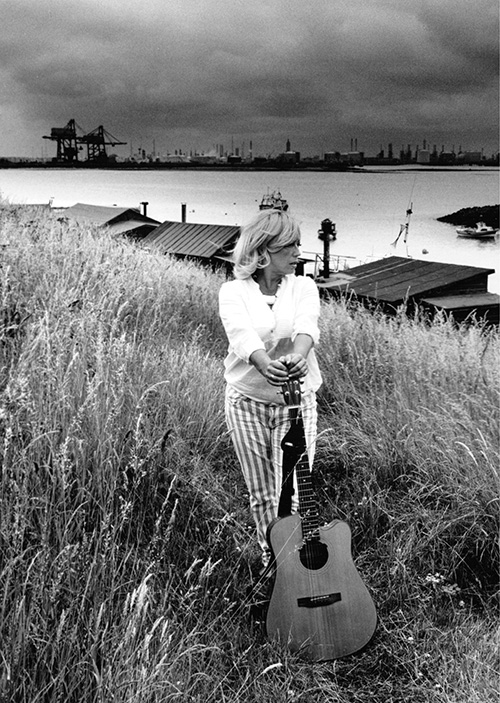
Essentially, peace of mind is exactly what I am searching for. In this hurly-burly life that we find ourselves in, peace of mind is certainly something worth having, so yeah, I love that song. And I love “Up To The Moon” as well, because it’s so positive – it’s about trying to win somebody back at the point of leaving, which is an interesting thing to do. The sad thing about art is that you have to pull stuff out of yourself, and you’re not always aware whether it’s going to hit the mark or not, whether people are going to appreciate it. And when they don’t, it can hurt. But so what? You move on. We’re not entitled to have everybody appreciating us all the time, that’s not something that you can plan for, but you never know. I’m still writing, and so I hope that I’ve got something somewhere that somebody’s going to pick up and put in a movie or say “This is a great song!” “The Moon Is A Powerful Lover” is something like that. That’s one song that we don’t do live, one I think we should do, but I did it live with my daughter and her husband – it was really cool, just the three of us.
But I don’t really work a lot with musicians, because the terrible thing is that, without having a manager or somebody to hustle for gigs, I am useless at that. What’s happened in the past is, I’ve put a band together, I’ve rehearsed everybody, and then they’ve never earned any money out of all the work that they did with me. So I’ve tended not to bother anymore and just play where I’m asked to play, where I will just turn up with my guitar. I did a gig in Scotland last year, went all the way there with my guitar, and it was very successful. Even though it’s just me, I can still entertain people, because I can talk a lot, as you can tell. (Laughs.) I tell some jokes on stage and have a bit of fun with people, I put them at their ease and share a bit of myself with them. That’s really what it’s about in a live context: sharing yourself and who you really are.
– Your love for dong backing vocals and your mingling with YES came together when you sang on Jon and Vangelis’ “The Friends Of Mr Cairo”…
That came about because I was supporting Jon Anderson. We played the Royal Albert Hall together at the end of our British tour, and Vangelis came to the gig that night. After the show, we all went out for dinner and then back to Vangelis’s flat for after-dinner drinks, at which point he sat at the piano and I stood next to it and sang my heart out. I can’t remember what he was playing, but I remember his fingers: he had the most distinctive fingers – they were like spoons. Incredible! I’ve never seen hands like it in my life. We had a little jam, me and Vangelis, and so I was invited to sing backing vocals on their album, which was a thrill. I thought Vangelis was fantastic, I really did. I’ve always admired him and his music. I love Jon, of course, but I knew him quite well through the years, and you don’t put people that you see a lot on a pedestal – you just accept them.
Jon was just one of Alan’s friends, and he was always so nice. I haven’t seen him, though, for many, many years. But I bumped into Rick Wakeman about fifteen years ago, and I saw Steve Howe at the YES reunion six or seven years ago when it was fifty years of the band. FRAGILE were invited to perform at the Palladium in London as part of a celebration of YES music, and YES were performing. Alan was there, and that was the last time I saw him. He was already very ill; he had terrible back problems. My poor Alan. It breaks my heart.
– You sang on Steve’s album too.
Yes, I did, yes. That was through my friendship with Alan and hanging out with the band that Steve was aware of me, I used to perform “Look Over Your Shoulder” with FRAGILE. Their guitarist, Oliver Day, is so accomplished! He was brought up with the music of YES and he’s a fantastic slide player. He’s now in another tribute band, called YES PLEASE, because he plays everything that Steve Howe, “The Clap” and other things. Really talented young guy. It was a pleasure to work with that band, even though I had to work hard to remember everything. It was a labour of love, and they were such nice people.
– Since we talked about Anderson, I’d like to ask about a song called “You Dear” that you did on “Abracadabra”: according to Wikipedia, it was written by Ian Anderson, but I couldn’t link it neither to the JETHRO TULL leader nor to his folkie namesake.
No, it’s by Jon Anderson, not Ian Anderson. Jon gave it to me. He said, “I’ve written this song, I think it’d be perfect for you to do!’ I think it is reminiscent of Jon’s work, but of course, it’s much simpler than what he normally would write. And yeah, it’s a song I’ve never tried to recreate in any way. I’ve performed the FREE song [“I Love You So”] that I recorded with a rock band – some friends of mine are a FREE tribute band, so I did that one with them – but I’ve never done “You Dear”.. Dear Jon. Lovely man. Absolutely lovely. Good memories, although the Seventies were, well, pretty hellraising.
– On the same album you recorded “Jamaica” whose a cappella intro sounds like a predecessor to your “Voices” album.
Oh, really? That was Doreen and Vicky, wasn’t it? But of course, I did that bit. (Sings.) “Take me to Jamaica where the rum come from – we can have some fun…” I was in Jamaica with Rory and Alan in the winter of 1974, over Christmas, a fantastic holiday, so when I went back into the studio, I put that one on the album, which was cute. But it was the first time I’d been in a poor country, and I felt very embarrassed about having any money, so I just kept giving it away. It really struck me, because I’d never been to India or the Far East or any other country where I saw people on the streets with no shoes on. We were robbed twice in Jamaica, but we didn’t mind: it happened on Christmas Eve, and we just went, “Oh, Merry Christmas to the poor people who’d stolen our money and stuff!”
And we were robbed the second time after Christmas. Alan and Rory had rented a shed, and I had rented a beach hut, which had a straw roof and wooden sides, but you could go under the roof and it was completely open. Alan and Rory hadn’t locked their shed door. and in the middle of the night, a cry went up: somebody had opened the door, grabbed Alan’s trousers and run out. So I got up at three o’clock in the morning, “What’s going on?” “Oh, we’ve been robbed. We don’t know what to do. They’ve got his wallet. How about you?” I said, “No, nothing’s happened to me. I’m fine!” But then, in the morning, all my belongings were laid out on the beach! They just reached in over the top where I’d be sleeping, grabbed everything and emptied it to see if there was anything worth having there. It was hilarious. (Laughs.) That was a trip and a half!
– What happened to you between “Abracadabra” and “Touchpaper”? You worked with WISHBONE ASH, but you didn’t record anything solo during that period.
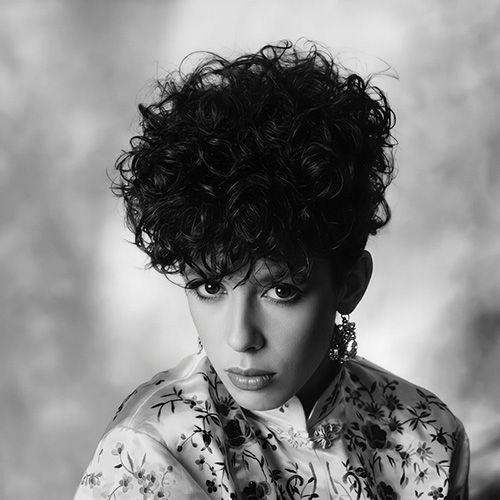
I was without a label. When punk was on the horizon, Tony Dimitriades saw the writing on the wall – he saw that anybody pre-punk was going to be dead in the ditch – so he went to America. He said, “I’m off to America. I’ve discovered somebody called Tom Petty, and I think he’s great. If you come out, I will help you…” But I don’t think he was willing to take me out there, he couldn’t afford it and he didn’t want to saddle himself. “If you need any help,” he said, “go and see John Sherry.” John was WISHBONE ASH’s manager. Also, I won’t say I hadn’t fallen out with Ray Davies, but again, the Ric Grech thing had happened, and that cleared the pitch with Ray, which was another reason why I was without a label. So I ended up living in London, without any money, feeling like I was all washed up, at the age of twenty-one. It felt like my career was over, because everybody wanted to sign punk bands, and I didn’t fit in, because I belonged to another era.
Had I perhaps been discovered at that age, writing what I was writing, it wouldn’t have worked, because the sound at the time was gritty. The only person that came out of that era with anything remotely pretty was Kate Bush. And because she had a visual image that was ethereal and gothic, and also a very weird, high-pitched gothic sound, she managed to skirt around the punk sound that was happening then. But I couldn’t do that, because I already had a history, and everybody knew who I was. And because I hadn’t made any money for anybody, nobody was interested. I think I made an impression in the world of female singer-songwriters, because my work stands the test of time if you like, but it was still early days for women. Even to this day, because I’m pre-punk, I’ve never been included in the annals of women singer-songwriters to admire. The punk era, that’s when a lot of female writers started to emerge, who were given more acknowledgement and acclaim, but – and I wrote a song with that line – my timing was all wrong.
So I started writing with WISHBONE ASH, and that meant that I had a job. Rock musicians were the ones that I knew and that I was listening to. The rock genre has always been something that I felt akin to, but the thing is, I don’t have a rock voice, I don’t have a soul voice, I don’t have an Adele pop-soul voice. I’ve never been able to do that sound – or wanted to. I’ve never tried to create my voice, I always just let it come out of me, I never wanted to push it in any way to sound like anybody, so I’ve fallen between lots of different stools. But I found a home with WISHBONE ASH that kept my body and soul together. Then I met my ex-husband, who emerged as part of the music business during the punk era, and I just thought, “If you can’t beat him, join him!” (Laughs.) I was very fascinated by what the music business was like from the other side, because I’d been as an artist all the way through. I wondered what it was like on the other side of the fence, so I married a man in the music business. He helped me make records, and that was very good. He paid for me to make some records, and that was great. And he also gave me the idea for the “Voices” album.
– In WISHBONE ASH you seemed to have a special kinship with Laurie Wisefield. You co-wrote “Living Proof” with him, and he played on “Ultra Violet Light” on “Touchpaper.”
That’s true. I love Laurie. He came to to the CLAIRE HAMILL BAND gig in London recently, and it was so nice to see him again! He’s adorable. We had a little bit of romance when I was in WISHBONE ASH.
– Was “Living Proof” your first writing credit on somebody else’s record?
I think it is. Yeah, you’re absolutely right. I wrote quite a few songs when I was with WISHBONE ASH: Martin Turner recorded “Halfway House,” and there’s a couple of others that have never seen the light of day. They weren’t songs that I could record – one was about being in the Navy and killing somebody that was raping a woman!
– A military subject was on the cover of “Number The Brave” during the recording of which you must have met John Wetton again.
Yes, we met again. Dear John Wetton. That was lovely to work with John again – he was a real character and a really, really nice person.
– “First Night In New York” on “Touchpaper” featured quite an interesting lineup. You had Simon Phillips and Morris Pert there, alongside John Giblin and Ronnie Leahy. Were you embracing your rock side again?
Oh, yeah. They were absolutely wonderful! And the drum intro to that song is just about my favorite drum intro in all of my songs. It’s very simple, but I absolutely love it. We do “First Night In New York” live now; we don’t do an awful lot of my old songs live, but we do this one. Simon Phillips was brought in by [sound engineer] Vic Coppersmith, and John Giblin was playing bass on the Jon Anderson tour. And of course, Gary Newman, bless him, did a little bit on “Ultra Violet Light” – he did that because a favor for Nick [Austin], because Gary didn’t do any sessions at all. He was so shy, and I must have sweet-talked him. but the fame that Gary had at the time!.. I remember being in the tour bus with him, and girls running down the road screaming, just like with THE BEATLES – it was astonishing for a shy person. Again, we occasionally do “Ultra Violet Light” with the band: we have done it in the past, but it’s not a song that moves around a lot. It’s atmospheric, but it’s definitely of its time – it’s definitely an Eighties song. We concentrate mainly on doing the newer songs to publicize the album.
– About atmospherics… We discussed “Voices” but still: how did this idea of four seasons come about?
I don’t know. Where do ideas come from? Out of nowhere. I didn’t know how I was going to do it, but for some reason, I thought I’d take the seasons and that would give me a framework. Then I worked out the vocals, layering them up in in sections. so it was quite mathematical in many ways, but also spiritual. I am a spiritual person, I’ve always been spiritual – I belonged to a religious peace movement called Focolare when I was young, and the very first international audience I ever performed in front of was on the outskirts of Rome, when I was twelve years old. It was very unusual to be taken to Rome, but that Focolare was formed in Italy after the Second World War. And that idea of a peaceful, loving world has never really left me.
– One of the engineers on that album was Tom Newman. Did you know him from the Manor, from the Seventies?
Yes. Tom and I were dear friends from those days. He’d walked into Nick’s office when Nick started the new age label, after he’d recorded an album similar to “Tubular Bells” in his studio, and he brought it to Nick to release. Nick said to me, “I think you need to trim yourself a bit – you are spending too much making albums, and if you record a cheaper album using a smaller studio, like Tom’s, in Hastings, then you will make some more money!” So I agreed to go down to meet Tom in Hastings – where I ended up living just on the outskirts – and his studio was very small. But we had some money in the bank. and I encouraged Nick to spend that money buying somewhere where we could put our own studio in. And Tom organized it. He helped us build the studio, and he came in to also to record “Voices”: the whole album took six weeks, whereas others had taken me months, trying to organize the sessions and getting somebody to do this, and teaching people the songs. It was an amazing experience for me – I didn’t have to teach anybody anything. I did it all myself. I just did it all.
– And then you sang on Tom’s album and on Dana Gillespie’s, too.
I did sang on Tom’s album, but Dana Gillespie… I’d forgotten all about that. She was a friend of [arranger] Tim Cross, who was recording for Nick. I did lots of work for Tim, mainly on a children’s magazine project that he was working on called “Story Teller”: every month he had to come up with a CD of children’s songs. So somewhere out there is a CD with me singing about a crocodile and other little children’s songs. Who knows when that will resurface? Maybe I should find them for my grandson?
– You recorded pieces titled “Glastonbury” on “Love In The Afternoon” and “Glastonbury Revisited” on “Summer” – but did you ever perform at the festival?
No, but my old school friend lives just outside Glastonbury, in Frome, and my daughters went to boarding school down in Glastonbury, so I started to visit it quite a bit, although it was miles away from where I was living. Glastonbury is an amazing place, it’s a beautiful part of the world, and I wrote that song about it. This is the funny thing about images, isn’t it? You don’t really know where they come from and why, but if you can grab something that will take you on a musical journey, that’s a lucky thing. I really love “Glastonbury” – that is one song we ought to do live, and I always perform it if I’m solo.
– You had an interesting line-up on “Love In The Afternoon” too, including Brian Willoughby and Nick Magnus.
All these musicians, they’ve they’ve done me such favors in my life! My sound engineer was friends with Nick, and he suggested that Nick come and play piano. We had a beautiful grand piano in the hallway, so we were able to run the microphones down through the house into the recording studio at the back. The albums that I’ve made in the last few years, I’ve always had to do quite cheaply because I didn’t have the money to to go into very big studios, but the technology improved, which meant that it wasn’t going to be too expensive. After having that 24-track studio of my own, I never learned how to record, and I always hated all of the wires and everything, even though, in my mind’s eye, I thought I’d be able to control everything when it came down to it. I do not like recording myself – I prefer somebody else to do it.
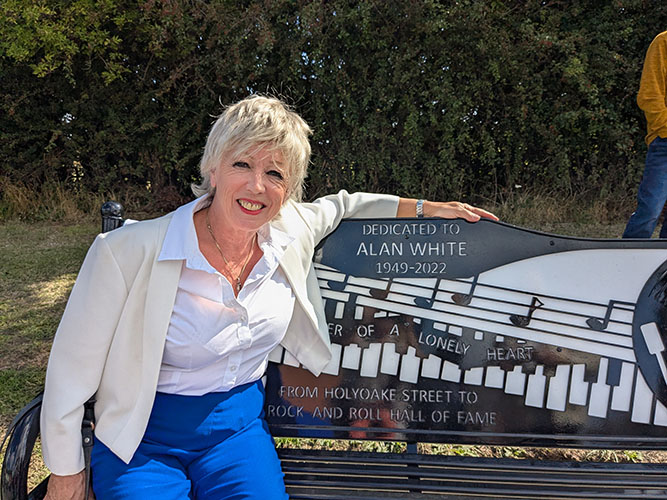
– Musicians aside, you have a song called “Singer”: who is it about?
It’s about this the singers that people love and that they don’t hear from when these singers don’t release anything. It’s always a bit of a bereavement. So it wasn’t really about anybody specifically – it was about a fan needing to hear a beautiful song that they could relate to and that would help them through a difficult time in their life. It has that tinge of something deeper and sadder about it. People do tell you that your songs and your music has meant something to them, and it’s most amazing feeling in the world – that’s your reward. That’s why thanks.
– You quoted Shakespeare on “This Duet” from "A Pocket Full Of Love Songs": “If music be the food of love, play on”…
“This duet” is definitely one of my favorite songs. I love everything about it: I love the way it builds, I love the way my voice sounds on it. It’s very expansive. And Shakespeare? Who doesn’t like Shakespeare? I find him difficult to understand sometimes, because of the old English language, but what a writer!
– Then, “Mother Of All” with Steve Stevens on it.
It was not my melody, it was written by somebody I knew that I’ve completely lost touch with. I think he died, actually. He was the local dope dealer in Hastings. When my marriage broke up, I started smoking dope again for four years and then quit, because it wasn’t good for me and not good for my voice, but I was dating somebody that smoked dope, so I used to go around and see this man. And one day he played this tune and I offered to turn it into a song. He co-wrote it with another young man that I’ve forgotten about, but I’m happy to credit him if he would get in touch. That’s quite a popular song, that one. It’s about the world, it’s about climate, it’s about Mother Earth and the fact that she will have her way in the end. If we all die, she will still be here, it’s not going to disappear. We don’t really know what state it will be in, but it will regenerate, just as Chernobyl has regenerated, in whatever way it had. Yeah, she will have a way in the end.

