


June 2026

It’s not necessary for a serious musician to be a character, but it surely helps, especially when the musician in question steadily refuses to take himself, albeit not his performances, seriously. Still, Steve Bolton, affectionately known as Boltz, couldn’t be anyone else, what with the arc of his career – if “arc” is an adequate geometrical term for zigzagging from the irreverent ATOMIC ROOSTER to the highly respectable Paul Young and then his own projects like DEAD’S MAN CORNER, from frolicking with John Otway and Richard Strange to touring the world with THE WHO because Pete Townshend happened to be a fan.
Leading the resurrected ROOSTER for the last ten years and having issued "Circle The Sun" in 2025, their first fresh album in decades, Bolton’s been busy lately working on this record’s sequel, yet Steve has so many stories to tell that he felt obliged to be generous with his time and delve into the most salient moments of a life well lived.
– Steve, let’s start from the end that feels like a new beginning: you buried DEAD MAN’S CORNER to concentrate on ATOMIC ROOSTER?
Yeah. DEAD MAN’S CORNER is my baby – it’s my band, my songs – and it’s been on and off with different line-ups. This line-up at the moment is fantastic, it’s my dream sort of line-up, but things are difficult on a local level in this present climate: it’s just hopeless, because small venues want you to play covers, and that’s not what we do. So it’s been pushed on us to knock it on the edge, and we’re going out with a bang at the beginning of next month. When our bass player left, we decided to bow out disgracefully. Me, I would carry on, so I don’t know what I’m going to do. I don’t really want it to finish, but it’s just what’s happened. It’s nothing, absolutely nothing to do with ATOMIC ROOSTER – that’s not the reason at all.
– I thought it was very conceptual, because you have this blackness with ATOMIC ROOSTER and DEAD MAN’s title also has this morbid connotation. I assumed you decided: enough of the gloom!
Yeah, maybe I’ll form a pop band, real bright and breezy, everything in major keys. (Laughs.) Let me tell you something about the ATOMIC ROOSTER situation, about the darkness. I was in the band when I was a little boy, in 1971, and it was okay, but with this revamped band, death and decay, and negativity within the music started to affect me after a while, and I thought, “I don’t know how much longer I can do this!” But then, when Peter French quit, we embraced the Edgar Allan Poe-ness of it all, and we do it with a smile on our faces. We treat it just like a Hammer horror movie: it’s not real, it’s not how we are. We’re just making music that fits in that, but we mean what we’re doing.
– Why was it you who was offered to reform the band? Why not, say, Chris Farlowe? You were not too long with the band, after all.
Oh, neither was Chris, and neither was Ric Parnell. When the agent phoned me about eight years ago, it was coming on in my vision anyway – people were asking me about the band – so I thought, “Maybe I could do better than provide a tribute act?” I made a couple of calls. I knew Vincent Crane was gone, but Chris and Ric were still alive, although Ric was living in the States. He was a good friend of mine, and we had a history – we shared an apartment, and he was my drug guru: when I came from Manchester, he showed me how to roll a joint – but his whole ambition in life, and I don’t say this too seriously, was to become a fabulous furry freak brother, and just smoke weed all the time, and he’d fulfilled that ambition. Sadly, he’s no longer with us, but I did think about Ric.
Pete French, however, was living in London, just near me, so I spoke to him, and it was down to Pete and myself to contact Vincent’s widow, who said, “Absolutely fine! I don’t have a problem with it. Go ahead!” The agent got us a bass player and an organist, and subsequently made a couple of changes, only it wasn’t working all the time: we did a few tours, but Pete was putting blocks in for us with regard to recording new material. We had a five-week tour of Europe, and after week one, Pete got a cold and went home, so Adrian [Gautrey], who was at the helm of the Hammond, stepped forward with a fantastic voice, and all of a sudden, we could spread our wings and ROOSTER could fly. (Laughs.) And now we’ve recorded a new album.
– What’s interesting about this album is that you perfectly captured not only the old band’s subject matter but also the original sound.
We haven’t deliberately tried to copy anything; it’s just the way we play. Adrian got us some time in a studio in a forest in Lincolnshire, miles from anywhere, so we went in there and we hadn’t even rehearsed. We don’t live near each other – I’m in London, and the other guys live in the northwest: Liverpool, Manchester – and we just had one quick get-together before a show, where we ran over some ideas. But we recorded the first five songs live in the studio, and it sounded fantastic – it sounded like ROOSTER! I don’t know what happened. Maybe some black magic gone on! (Laughs.) We had two sessions, one three-day session and then a four-day session, and in those seven days we got the album and mixed it. We enjoyed recording, and when we finished, we were really pleased with what we’d done, and we couldn’t believe that we did it in such a short space of time.
– But you consciously referenced classic ROOSTER titles, right? “Last Night” harks back to “Tomorrow Night,” “Rebel Devil” to “Devil’s Answer” and “Walk With Me” to “Death Walk Behind You”: you’ve been playing with fans’ perception.
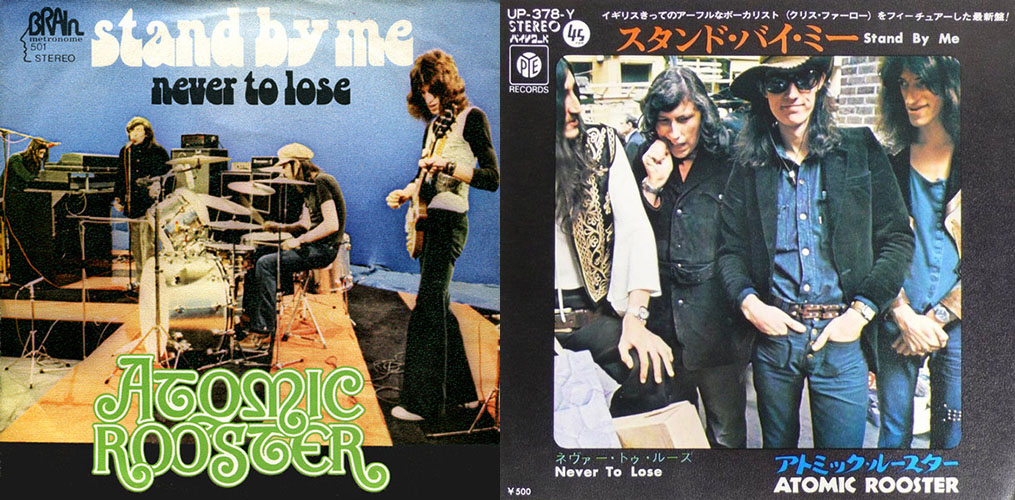
Well, yeah, obviously, I can’t deny that. I didn’t think of that when I wrote some of it, though. My wife and I have a camper van, and we went away for the weekend once, I had a small guitar and I came up with a chord progression, so I said to Louise, “I think I’m going to call this ‘Rebel Devil’…” She replied, “You can’t!” But I said, “I love it. It’s a great hook, ‘rebel devil’! It’s about some sort of wayward guy who does his own thing!” The thing is, when you’re writing to order, which I’ve never done, if you’re writing for a singer or a band, like these old songwriters back in the day in The Brill Building, you’re going to write in that style. So there was a certain amount of that going on. But “Never 2 Lose” is from when I was with ROOSTER, from the “Made In England” album; “Never To Lose” was the first song I wrote, and it was released as a B-side of the “Stand By Me” single, and now we redid it. I rewrote the middle bit, and Adrian obviously has written these quite tRic y, little jazzy rock things, but there was absolutely no cynicism at all in how we did it. We ran over the tracks three or four times, as you do, and did the vocals afterwards. All the guitar and all the keyboard solos were done on the backing track, so it was no like going in there and re-recording it.
– Since you brought it up, how often do you bounce your ideas off of your wife?
Louise has a very serious job: she works with social services and she brings dysfunctional families together and sorts them out. We’re talking all sorts of dysfunction you can possibly imagine, which were not in my realms of existence when I grew up. Her office is at home, in the house, but she goes out to deal with these really difficult situations, but apart from that, we spend almost all our time together. We love each other and we’ve been married now ten years, but before that I thought my life was over – and then I met Louise and, all of a sudden, life had a new meaning. Still, I like certain stuff, like rockabilly music, and she doesn’t like it. Rockabilly is a quite difficult thing for a guitar player – I saw bands like THE STRAY CATS many times live back in the day, and they were very technical – so even though I’m not quite old enough to have been into rock ‘n’ roll the first time in the Fifties, when I was still a child, I like to go to rockabilly festivals. But Louise goes, “Why would I want to go there? It’s all fancy dress!” – but we have a good time. Yeah, she’s my kindred spirit and my savior.
– It’s interesting that you mentioned rockabilly. You look the part, but you don’t really play those licks.
I do like the rockabilly style, but I’m into all kinds of music – well, not every kind, but I’m into psychedelia, but if psychedelic music is really obvious I don’t like it. I like stuff that is psychedelic, but you hang about and think, “This is not quite right. This is a bit odd, isn’t it?” That’s the best kind of psychedelia! That’s why I’m into SLY AND THE FAMILY STONE. To me, Sly Stone is a god, and so is Jimi Hendrix, and so are THE BEATLES. I’ve got the quiff, and I’ve had periods in my life where I haven’t had it, but so what? Yeah, there’s no rockabilly in ATOMIC ROOSTER, but you never know. Maybe on the next album, there may be a rockabilly influence! (Laughs.)
– Well, you have this twang when you play, and you began in a rock ‘n’ roll band, THE DIMENSIONS that Rod Stewart in it, and Louis Cennamo had been members of. They became stars early, but you were a late starter. Why?
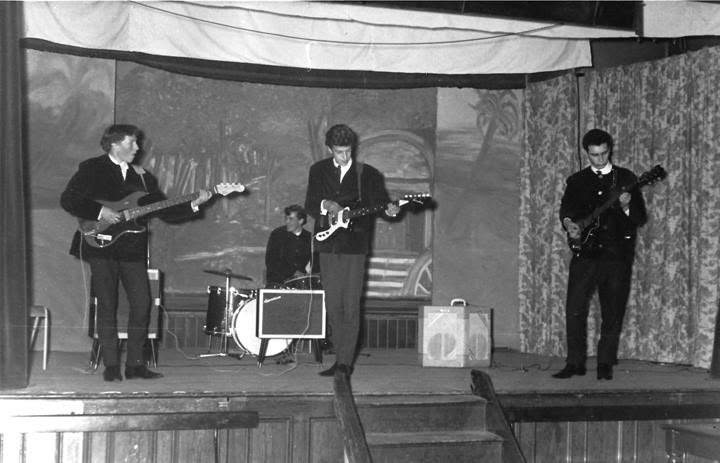
Of course, I’m a late developer! (Laughs.) I was living in Manchester, when I did my exams at school, but I never went back to collect the results; I went straight to Birmingham, and joined this band, JIMMY POWELL & THE 5 DIMENSIONS. I was in it for a few months, but it didn’t really work out, and I went back to my parents with my head held down. And then we came to London, with the band I had in Manchester, because we thought we had to be there to do anything, as you did then – I mean, now you can be and do that shit anywhere in the world, but not then – only the band immediately split up.
The others went back home, but I hung on. I sofa-surfed, I stayed in people’s apartments, and within a few months I ended up getting a job, playing guitar in Soho, in a strip club. I’d start at two o’clock in the morning and get home about seven, and that’s when I answered the advert for ATOMIC ROOSTER, because back then you had the music papers, and in the back they had the adverts. I phoned Vincent Crane, although I wasn’t really a lead guitar player, I was a rhythm player, that’s what I wanted to be, but I got the job, eventually, after two auditions. Immediately, I went to America, then came back, then went to America again. You’ve got to remember that in 1971, touring America was like the Sixties, it was completely crazy: all the gigs, people smoking grass and hanging off the stage – I thought, “This is fantastic!” We got into all sorts of capers with Ric Parnell there. We had an apartment in North London, and we were like a magnet – visiting musicians used to come and stay with us, get high and do all this stuff. it was good times!
– Were you familiar with ROOSTER when you saw their ad?
One of the bands I saw back in Manchester was THE CRAZY WORLD OF ARTHUR BROWN, with Vincent Crane, Carl Palmer and, I think, Nick Graham: I can see it even now in my mind’s eye – this was fantastic. Arthur had the flaming headdress, and it was like, “Whoa!”; and Vincent, in a robe and with his hair was flying around, had a huge Hammond, and it melted the keys, so they were dripping like candles. I didn’t think for one minute that, two years later, I would be playing with him, it just didn’t make sense. The same thing happened with THE WHO: I saw them three or four times, and never did I think that I would be playing with them one day, but there you go – it happened, I don’t know how.
– What did you want to bring to ROOSTER? I mean you didn’t try and replicate John Du Cann’s manner. You played, right off, in your own style.
Now I’m a fully developed lead guitar player, at least I think so, but in my very first band, when I was fifteen and we played SHADOWS and a couple of BEATLES songs, I wanted, as I mentioned, to be the rhythm guitar player. We had a guy in my school, a year older than me, who was walking up our street up the road with a guitar case once, and I ran out and said, “Oh, you’ve got a guitar!” So he played all the lead lines, but he couldn’t play chords, and even in the band I came from Manchester with to London, we had two guitar players. When I got the job with ROOSTER, I was staying with a school friend of mine, James Litherland – he was in one of my bands, came to London a year before me, and joined COLOSSEUM – and he showed me some quick licks to get me by – Joe Walsh from JAMES GANG, Steve Marriott and HUMBLE PIE – but I brought a more rhythmic style to it. We’re doing a lot of the new album in the set, and some of early ATOMIC ROOSTER, but I cannot copy other people, that’s always been my thing, and also it’s very difficult to walk in someone else’s footsteps, so I developed my own style, which is more rhythm-based.
– Was “Stand By Me” your first ever-recording – not only with ROOSTER, but at all?
I’d done a recording with my first band, but that was something else – it was all new learning experience. I can’t remember where we did those recordings, I think it was Pye Studios in the West End of London, but there’s ATOMIC ROOSTER’s “Live At The BBC” album that was done in a theatre on Lower Regent Street. It’s got tracks like “All In Satan’s Name”: it was a Ric Parnell song, which I love, about a cosmic chess game, Ric didn’t play an instrument, but he heard the lines in his head, so he would sing them to me, and I would interpret it onto guitar and go through the whole thing. And I can remember Ric and I driving in my car into the center of London, to that theater, where we just parked outside, going in there and playing in front of the audience. When I hear this album now, I’m right there.
– You mentioned “Never To Lose” which is interesting, because you created a kind of guitar orchestra on it.
Yeah, there is that, in the solo section, but we’ve changed it for the new version. I was in the band eighteen months, and for the first four months probably, Pete French was the singer; then he got invited to join CACTUS, so we had to find a replacement. and I spoke to Ric about getting my friend in, who was in the band from Manchester. I remember Vincent going, “No, no, no, I want Chris Farlowe to sing!” – but we thought it was the wrong move. Chris was a great singer – still is – but he’s got another side to him, and I don’t think he liked me that much, although that’s by the by now. The funny thing is, we played a festival in Poland about five years ago, so I’m at the hotel, at the bar, and this promoter’s asks, “Steve, do you ever talk to Farlowe?” I said, “No, I haven’t seen him since 1972,” and right then, Chris comes out of the (Shindlers)lift: “Steve, how are you doing?” He gives me a big hug, and I think, “Well, that’s weird, isn’t it?”
Back in 1971-72, Chris would never travel with us, because he had a shop in London that sold war memorabilia, so he used to drive himself around in his Range Rover, when we did a lot of work in Europe, to buy that. One time, we were driving across Bavaria or somewhere in a car, with a driver; Vincent Crane was in the front and, for some reason, Chris Farlowe was in the back with us – I’m at one side, Ric Parnell’s at the other, and Chris in the middle. We started arguing, and Ric was trying to needle Chris, saying, “What is it about you and all this German memorabilia?” The argument got a bit heated and reached a point where we all stopped speaking, so I looked out the window, and I think Ric was looking out the window too, but after a minute or so this voice started singing “St. James Infirmary” or something, and it was the most beautiful thing I’d ever heard! I looked at Ric, and he looked at me, and it was at that moment that we realized: sometimes it doesn’t matter where the voice is coming from, the voice is just there. Even though we didn’t agree with Chris and his politics, when he started singing it was the voice of an angel.
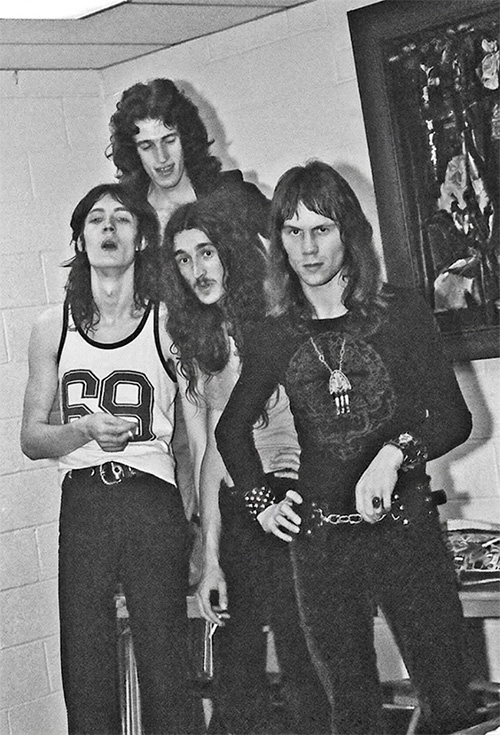
Ric Parnell, Steve Bolton,
Vincent Crane, Peter French
– Who was more interesting to work with, in creative terms: Chris or Peter?
Chris was a true professional, I think even he himself would say he’s musically adaptable – he’d just sing with whoever’s paying the wage.
– Way back, there was a song called “Space Cowboy”: acoustic-based, with the Spanish tinge. How did you come up with that part?
We do this song in the set now! We do a couple from “Made In England”: we do “People You Can’t Trust” and “Space Cowboy” – and I preamble it with “This is the first song I wrote…” – and then we do “First Impression” which is the most recent one. I never thought we would play “Space Cowboy” live; it was just a little acoustic guitar riff I came up with, but Chris did a fantastic job on that.
– Did you ever think about the song of the same title by Steve Miller?
And also SLY AND THE FAMILY STONE! They had “Space Cowboy” on “There’s A Riot Goin’ On”! I never thought about it at the time, but it’s a psychedelic image, and that’s why it had a kind of cowboy-like guitar part, diddling down right in the ranges of the universe, and a synthesizer, one of the early Moogs. It was a bit of a comedy song, but people like it.
– Talking about cowboys… I heard about your and Ric’s shenanigans during ROOSTER’s American tours.
Yeah, I was like a child in Wonderland. I’d never seen anything like it. Every English musician wants to go to the States, because it’s where their music is from, but on the same hand, Americans loved English musicians, so it was a mutual respect. And the gigs were interesting. I remember a problem we had on our first concert – in a college on Long Island or somewhere near New York. Because there was no bass, I used to tune up on stage: Vincent would give me a note on the Hammond, I’d tune the guitar, and we were good to go. That time too, he gave me an E, and I tuned the string, but I felt something was wrong. I thought, “Why am I keep tuning it up? – and then the string snapped! Not a good start to the concert! (Laughs.) Vincent gave me a B, and another string snapped. So we just walked off stage, unceremoniously, with the management in panic.
It turned out that a Hammond organ, which has a thing called a tone wheel that generates the sound and runs off cycles per second, needed a cycle changer, because in America the voltage is 110 volts, and in the UK and Europe it’s 220, so even though we’d adjusted the voltage, the cycles per second weren’t adjusted. There were only two changers available in the whole of the state, so we had to get one by the next gig, at great expense. The first concert was memorable for that reason for me. And then we were just off into America to find out that, while the West Coast and the East Coast were entities unto themselves, when you went into Middle America, as we did, it’s just jeans and cowboy boots.
– You toured there only with French? You never came back with Farlowe, did you?
No, both tours were with Pete French on vocals. And I remember a gig when Carmine Appice from VANILLA FUDGE hung out with us – I’ve got pictures somewhere of him smoking a bong with Ric and myself – only he was there to poach Pete. He and Tim Bogert wanted a Rod Stewart-type English vocalist for CACTUS, so when we got back after the second tour, Pete announced that he was leaving. Let me go off a tangent a bit and remind you of a band Tim and Carmine formed after this, with Jeff Beck, called BBA, that also was short-lived, because I think their whole management was sort of mafia. There was always something going wrong with those guys, and when Jeff got involved with them he had a really bad car accident, so it was rumored that it was not a coincidence, and Pete French was sent packing after the “‘Ot ‘n’ Sweaty” album because he was sick, and I don’t think he’s ever got over that.
But anyway, Ric and I used to go to this club in the West End of London, called The Speakeasy, which was a musician’s hangout. It started late and went all through the night, and one night we ran into Jeff Beck who was with Carmine, and at four or five o’clock in the morning we decided it would be a good idea if we all went back to our apartment in North London. Ric and I had had a small car, Carmine had a Volkswagen Beetle rented, and Jeff had a Corvette Stingray, so we went the five miles. Jeff Beck was pretty stoned at this point, or drunk, because his Corvette was swerving all over the road behind us. We get to the apartment, all of us congregate in the small kitchen – although Jeff Beck was just distinctly not part of the conversation, as he was already a bit far gone – and then, all of a sudden, the lights go out, because we had this very quaint thing in England: an electricity meter that we put coins in. So we sit in the pitch dark, and I say, “Has anyone got 5p?” – “No, no, I haven’t got!” And then I remember my German girlfriend had bought me a candle of Dracula, Prince of Darkness, with a wick in his head. (Puts a finger to the top of his head.) I light it and put it in the middle of the table, and we start skinning joints up. Just then my girlfriend opens the door of the kitchen, (adopts German accent) “What the fuck are you doing? What is going on here?” I get up and I say, “Be cool, I’ve got Jeff Beck and Carmine Appice here!” And she goes, “I don’t give a fuck who they are!” – and then she sees the candle: “Was ist los? You’ve lit the fucking candle I gave you as a present!” She was a bit feisty! (Laughs.)
So, yeah, getting back to ATOMIC ROOSTER, there was a lot of drug-related stuff. I shouldn’t go down that road, but it’s funny. I always shared a room with Ric in America, but onstage, he would grab the microphone before the final number and announce, “Steve and I are in the Holiday Inn around the corner. We’re in room five, six, four. If anyone’s got any weed…” I’d be like, “Why did you do that? You get all these weird blokes coming, queuing up, smoking weed, but where are the girls?” Then one night we go back to the hotel, and Ric don’t have any weed, which is a big thing, but in the banqueting suite of this Holiday Inn are a bunch of people, all sat on the floor, and we see one guy rolling a joint, so we sit next to him, cross-legged, and he passes the joint to Ric, who smokes it, passes it to me, and I smoke it too.
And then the guy leans over and goes, “By the way, don’t take more than two hits off that joint because it’s got angel dust in it…” Within thirty seconds, it’s like, bang! All the lights are flashing on and off in my head, then everything goes black and white, and I see the police and the army are coming, guns are firing, the horses galloping through the room. I’m hanging onto Ric, and this shit seems to go on for three days – three days of pure hell. Eventually, we come down, and the next morning Ric says to me, “That was quite good, wasn’t it?” But no, that wasn’t quite good – that wasn’t good at all. It’s the worst thing that’s ever happened to me. I must say at this point, I’m completely clean now, I don’t do anything, but this is all part of my research when I was much younger.
We even played in Salt Lake City on that tour. We had an American tour manager called Henry Israel; he was cool, but he was looking after Ric and me, and we needed a lot of looking after. One time we were flying from somewhere down South up to LA, and we thought we had three days off, so Ric asked me, “Hey, why don’t we take this LSD here that I’ve been saving?” Now, we do it, and the minute we do it, we’re on this plane, and Henry says, “Oh, by the way, guys, we’ve got an unscheduled stop in Salt Lake City, and we’re doing a gig for the Mormons!” We go, “What? You can’t be serious!” But he was. I asked, “Well, what about the equipment? We don’t have that!” But they would supply us with it. I’ll always remember looking out the window and seeing the lakes that were beautiful: purple and mauve, and magenta. We were like, “Oh, yeah! Cool” And then we landed and got met by a bunch of teeth, Mormon teeth (bares gums with his finger) – by security guys with crew cuts, you’re saying, “Hey, welcome to Salt Lake City!” Ric and I thought, “What the fuck?”

for “Made In England”:
Steve Bolton, Ric Parnell,
Vincent Crane, Chris Farlowe
We were taken to a circus, a huge American touring circus, with sawdust, and there were hundreds of people, all with teeth, looking down us. And the equipment they’d given us was was a joke, really – a cheap organ for Vince, “My first drum kit” for Ric, and some unplayable guitar for me – but Pete French was completely oblivious to this: he was ready to be stood at the mic like this (strikes a pose) and rock. Then Ric’s going, “Look at this!” and throws the stick in the air, and the stick’s spinning around in slow motion and coming down. And I say, “No, look at this!” and I throw the guitar up in the air, and it’s spinning around. And we’re both like ballerinas: we’re dancing, we’re dancing. And I look at Vincent Crane, and he looks like some sort of weird hawk or a big crow. He counts in, “One, two, three, four…” – and Ric and I know that after four we have to do something, but we don’t quite know what we have to do! “One, two, three!” And we went, “Oh shit! Try it!” We just start off – and then there’s a flash, and we were being taken back to the limousine, like naughty chimpanzees. All of a sudden, we aren’t welcome anymore. I don’t know what the fuck happened, it was a complete blur.
We were off our faces. I’m not proud of it, I’m not proud of it. Years later, I worked with Donny Osmond, and he asked me, “Steve, were you in a band ATOMIC ROOSTER?” I said, “I was.” And he said, “Yeah, I heard stories…” (Laughs.) It was all jolly good fun, but America is such a huge place, and I realized then that we weren’t actually making any inroads into it. The “Made In England” album, Vincent had it in different color denim sleeves, because he thought the Americans would like that, but by the time it got released in the States, they changed the cover and put a generic rooster on it.
– Did Vincent’s psychological problems ever manifest themselves during the time you were in the band?
Well, no. But he was a very delicate guy, Vincent, and he did tell us about his time in a mental hospital that was after THE CRAZY WORLD OF ARTHUR BROWN. They got a bit high and he never came down, a bit like Peter Green, and it was very difficult for him, I guess. I always thought he was a sweetie, and I really got on with him, but Vincent’s wife at that time, Pat, who was helping him, thought she was some sort of witch, and it complicated things. After eighteen months, I decided to leave ATOMIC ROOSTER, and I told Ric about it somewhere on the road in Germany, and Ric came up to me and said, “He knows. Vincent knows!” I asked, “What do you mean, ‘he knows’?” “He knows that you want to leave!”
Then I got a phone call from Vincent Crane: “Steve, I’d like to have a word with you. Will you come down to my hotel room?” So I go down there, and there’s Pat is on the bed doing the Tarot cards, and Vincent says, “Steve, I’ve heard that you’re thinking of leaving…” I say, “Yeah. You know, I’m young, I want to get on and do stuff!” And he replied “We don’t really want you to leave. We really like what you do, it’s great.” I said, “No, I’m leaving.” And he changed, he went for attack: “You can’t leave because you’re under contract!” I said, “No, no, no, no, no, I’m not under contract for anything!” He looked across at Pat, “But you can’t leave, can you?” – and she was saying something. I said, “I’m definitely going, so don’t try that black magic voodoo on me!” He was always caught up in that world, but maybe it did put a curse on me. (Laughs.)
– So was this dark concept of ATOMIC ROOSTER related to his mental state or it was Pat’s influence?
In retrospect, in a lot of the songs, all the signs of his mental issues were there, weren’t they? I don’t really know the first ATOMIC ROOSTER album, the one with Carl Palmer and Nick Graham, who was a great singer, but when we started to rehearse, we did a soundcheck to a song called “Banstead”: (sings) “Please take me out of this place…” Now, “Banstead” is the title of the song, but Bandstead is also the name of the mental hospital that Vincent was incarcerated in during that time. I don’t know how long he was in there. I ran into Vincent a couple of times after I left ROOSTER, and he was always very sweet, but I think of his life: he went to play with DEXYS MIDNIGHT RUNNERS, which was a weird thing, and then he ended up in an one-bedroom apartment and took an overdose of pills. Bipolar is a heartbreaking condition.
– Why did you want to leave, though? Had you already talked to Mark Ashton about forming HEADSTONE?
Yeah, that was a catalyst. When you’re with somebody and you meet somebody else, it doesn’t matter what they say to get you back, and even if they do persuade you to go back, it will never be the same. I met Mark Ashton, and I thought, “This is cool!” It’s like CREAM was Eric Clapton’s best period, in my opinion, with what he was playing on “Disraeli Gears” – but then he heard “Music From Big Pink” by THE BAND, and he decided it was better. I heard the music Mark was making, and it was the kind of music which was similar to that: it was more gentle, country-rock type, and it was away from that ugly ATOMIC ROOSTER music that I thought I didn’t want to play anymore, that I wasn’t happy with, especially because Chris Farlowe didn’t like me. And once I’d made my mind up, that was it.
– Mark was a drummer who suddenly became a singer. How did you meet him?
ATOMIC ROOSTER did a gig in Belgium, outside a shopping center, and Mark Ashton was our support act. He was playing acoustic guitar, like a Donovan-type, singer-songwriter character, so we got chatting, and we really hit it off personally. We liked each other, I jammed with him on a couple of songs, and then we decided to get a band together. He had a record deal with EMI, and we did two albums as HEADSTONE.
– I love those records, but I noticed that you never actually wrote anything together, you and Mark.
No, not together. It’s a funny thing, writing: when people write together, I often wonder how they do that – how is it to actually sit in a room with somebody else and write. You can have a verse and play it to the other person, and then maybe they have some idea, and you can marry the two bits together, but to sit and write together, no, we never did that. I’m going to do that with Adrian Gautrey on the next ROOSTER album, though – it would be a good thing to do that. It’d be good for all of the band as well.
– When you started HEADSTONE, was it only you and Mark, or Phil Chen was already in the picture?
No, Phil Chen and Chili Charles, the drummer from the States, were booked as session guys. We did our first album down in Rockfield Studios, on a farm – it’s now a famous studio, OASIS and lots of other people recorded there, but when we were there, it was just a small eight-track studio, – and we stayed in a little house at the top of the hill, this outbuilding with bedrooms in. And I’ll always remember Philip Chen, because we had those blankets on the beds, and Phil – God rest his soul, I first saw him with Jimmy James and THE VAGABONDS way back in Manchester, but he ended up playing with Rod Stewart, and I still spoke to him till the end, he was a sweet guy – was always complaining about them.
Philip was Chinese, but he spoke like a Rastafarian, because he was born in Jamaica, so it was like, (assumes patois) “What they’re giving us donkey blankets for? I can’t sleep on no donkey blanket, man!” That’s why on the credits it’s “Philip Chen, bass and donkey blankets” – because he made a big deal about it! (Laughs.) Then, by the second album, we’d got a proper band together, we had Pete Van Hook on drums, who’s quite well-known now, Jerome Rimson, a bass player from Detroit, who was over in London with a band called DETROIT EMERALDS but he jumped ship and stayed in England, and an electric violinist, Joe O’Donnell.
– You would later play on Joe’s "Gael's Vision", too.
That’s right. We had a flat together then, because Ric got married and moved out, so I ended up sharing this flat in Crouch End – now it’s a uber-trendy part of North London that I suppose was all right then – with Joe, which is funny, because he was very Irish, and we’d get into these heated discussions, Joe and I. We talked about quasi-religious mysticism and everything, and when we’d reach a point in the conversation where it wouldn’t continue anymore, Joe would always go, “You know, you wouldn’t understand it, because you’re not Catholic!” (Laughs.) But Joe and I were listening to MAHAVISHNU ORCHESTRA, and we were just completely besotted with it – Joe, especially, with Jerry Goodman on violin. So we had this thing going on, where Mark was writing pop-rock songs, very good melodically but very simple, and Joe and I would come up with these lines that would weave in and out of it; live, Joe would be at that side with his electric violin, and I’d be the other side, and we’d play it like MAHAVISHNU, on a lot of stuff you hear on the second album.
It started when Ric and I were coming back from some ATOMIC ROOSTER shows in Germany, and we got a taxi from Heathrow Airport to Muswell Hill, where we were living; the cab driver had the radio on, and we heard this track, and we both went, “What’s this? This is fantastic!” He said, “That’s John McLaughlin and his new band, MAHAVISHNU ORCHESTRA!” So we went and bought “The Inner Mounting Flame” and listened to it quickly during the day, but that nigh, we had one of our many gatherings, where musicians would come as I mentioned earlier, and we did some LSD and listened to some great music: Captain Beefheart, Sly and THE FAMILY STONE, Todd Rundgren – and at one point, we put the MAHAVISHNU album on. The first track went, “Bang!” – and this flame went around the room. You’ve got to remember that we weren’t preconditioned for this, and neither were the other people, who didn’t know anything about it, but it just went right out there.

They were a special band, and we saw them live a couple of times, me and Ric. McLaughlin, he’s a jazzer, he played with Miles Davis and with THE TONY WILLIAMS LIFETIME, with Jack Bruce – we did a gig with them in Manchester before I came to London, and I remember it being a discordant, jagged and not very attractive music – but with MAHAVISHNU ORCHESTRA, it was different. John used two Marshall stacks, rather than small amps, and it was full tilt. They had a live album, recorded in Central Park, “Between Nothingness & Eternity,” and there’s one track where the band breaks down and McLaughlin is on the twelve-string neck, and he’s going on these weird harmonic minor scales, and you can hear the guitar starting to howl because the volume he’s playing at is so fucking loud, and you get this power, and then he gets right up to the top of the neck and turns round, and he’s holding the guitar against the amp for feedback!
– Are there any live recordings by HEADSTONE?
There was a live recording, yeah, but I don’t know where it is. I had one on cassette, but I threw all my cassettes away, as we all did. I had a box full of cassettes when I moved apartment about twenty years ago, and I thought, “What shall I do with these?”
– A couple of HEADSTONE songs were covered by STEVE DRAKE BAND. Did you ever hear it?
Oh, I didn’t know about that. Let me check it out. (Finds it and listens.) That’s so weird! I’ve no idea what’s going on here – it sounds like he’s sang over the top of HEADSTONE track, and he’s saying he wrote those songs!
– You had a song called “30B” on the “Bad Habits” album. What does it mean?
I don’t remember. We were just trying to be clever with all these initials. (Laughs.) There’s also a song of Mark called “DMT”: DMT is the name of a recreational drug, but it’s nothing to do with that – Mark had this sort of arrogance, and he called this song “Doing My Thing”! When he told me about that, I said, “Excuse me? You can’t fucking call it that! Just call it ‘DMT’!”
– What about your song “Gyrosame” on the “Headstone” album?
That was “Gypsy Dave, Ross And Me” – named after the characters in the song – that I shortened.
– You sang “Gyrosame” and “Searching Light” on that second album. Was it the first time that you handled lead vocals?
Yeah, I’d never sung before. There are certain people who can sing, but where did they get that voice from to be able to do it? Where did Stevie Marriott get that voice from? Where did Terry Reid get that voice from? How could Robert Plant sing like that when he was seventeen? Chris Farlowe has got it, he can sing with a soulful voice. It’s got to be like a heaven-sent talent, hasn’t it? Some people can do it, but I was aware that I wasn’t one of those people, and I always felt, when I sang, that I was a bit of an imposter. So it took me a long time to be able to sing, but even though I can sing in a certain way now, I wouldn’t consider myself a singer.
– You had more songs written for the second album, “Large Weather We’re Having, Lucy ” and a few others.
I don’t consider myself a songwriter either. It’s hard work to write songs. There’s a story about Leonard Cohen struggling with “Hallelujah” asking Bob Dylan how long did it take him to write “Like A Rolling Stone” and his Bob-ness saying, “Ten minutes!” It doesn’t come easy, songwriting. The first HEADSTONE album was great, but there was no real band: Mark and me put all the backing tracks down with Philip Chen on bass, added drums, and then we would put electric guitars on top. And then we got a band together with crazy people like Joe and Jerome, and Pete Van Hook, and we all started writing more.
– You gave Jerome a lead vocal on a song called “Karma” on the second album.
He wrote it, that was his song, and I’ll tell you who else is on that track, “Karma”: Chaz Jankel from Ian Dury and THE BLOCKHEADS. These were all people that used to come to our apartment. Jerome was a wild man, I still in touch with him. And I ran into Pete Van Hook – we called him Rick Tickler, because he didn’t really hit the drums, he approached them in a jazzy way – somewhere in America, when I did THE WHO tour and he was playing with MIKE AND THE MECHANICS. He was involved in the LinnDrum, an inevitable thing, together with the Fairlight computer, which cost as much as it cost to buy a house – and now I’ve got all that shit in my computer here! (Laughs.) They were good times, when we worked together.
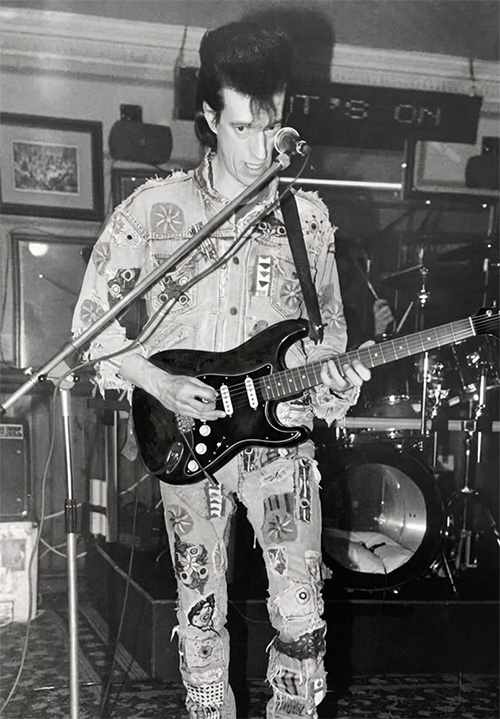
EMI put us into Clearwell Castle, where we rehearsed in the basement for two weeks , and then we decamped to Rockfield Studios, which was quite unknown then. We did the first album, Mark and Me, in Rockfield, and it was just an eight- or sixteen-track studio, but by the time we did the second album, there were twenty-four tracks – much bigger and different rooms. I still occasionally listen to the second HEADSTONE album. That was a good band, but as it happens with all bands if they’re not successful after two or three years, it imploded. We did two tours, one opening up for John Cale, when Chris Spedding was in the band, but then we all drifted off and did other things: Mark went to live in America and tried to further his career there, and I began working with people like Richard Strange and John Otway.
– Since you and Mark started off writing on acoustic guitars, is there any chance for the two of you getting together again and doing an unplugged thing?
You put that seed in my head now, so you never know. (Laughs.) Mark lives in France now, and we occasionally speak, but last time we met about ten years ago on the north coast of Kent – his brother has a music shop in Margate, and Mark was over. I hadn’t seen him for a long time, and I remembered him as a very pretty boy, like Paul McCartney-pretty, and there was this 65-year-old bloke – but it was great to see him!
– Your second album featured a cover artwork by Hipgnosis. How did that come about? And did that mean the band had a big budget?
I don’t really know how it came about. It wasn’t my record deal, it was Mark’s – ATOMIC ROOSTER was the first time I’ve ever signed a record deal at my age, but I do remember meeting Storm [Thorgerson] and the other guy, [illustrator Colin] Elgie, I remember going to their offices. Hipgnosis didn’t come cheap, so EMI probably footed the bill for that, because we were on a retainer, so we didn’t starve, which was good. Before we did a tour of the UK, they sent HEADSTONE out to Florence and put us up in a hotel, and we rehearsed in a nightclub during the day, every day to get it together. So there obviously was a budget, but I didn’t see any great amount of money, and I don’t believe I’ve ever got any money from any of the songs.
– How was it working with John Anthony, who produced both HEADSTONE albums?
It was great, and we’re still in touch. I did some stuff with John after HEADSTONE, with Nic [Potter], the bass player from VAN DER GRAAF GENERATOR, who did an album [“Sketches In Sound”]. I learned a lot with John. We experimented a lot, and “Bad Habits” was the first time I ever played through a Leslie speaker. To do that, you have to have an external foot controller – you can’t just plug into it because it’s not good for guitar – and these speakers spin around, so most people just mic the top and the bottom speaker, but John would put two mics on the top speaker, on the horns, and two mics on the bottom, on the bass speaker, and then he would have them in a figure of eight in the stereo mix. He did little things like that that were brilliant.
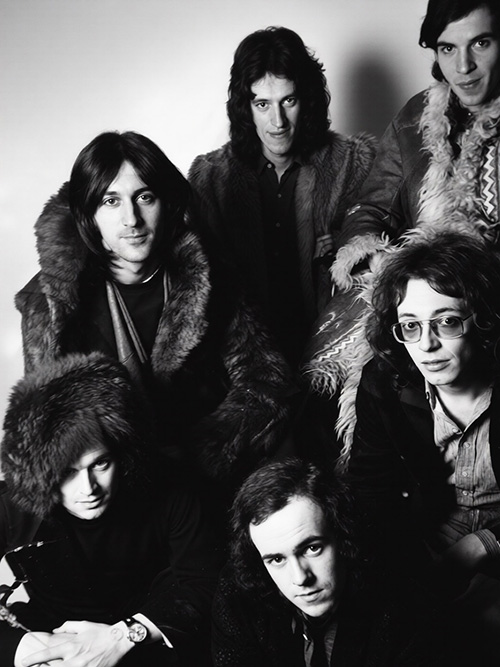
Steve Bolton’s last Mancunian band
But there was one incident where we were doing some stuff in a studio in central London with HEADSTONE, when John would slip me some drugs and we’d get high. We were messing around on guitars, so Mark Ashton turned around and said, “Are you two okay?” We went, “Yeah, we’re absolutely fine. Don’t worry!” – but we got to a point where we couldn’t go on, so John said, “Come on, I’ll treat you to a night down ‘The Speakeasy’!” We went there, and I had my guitar with me, and as I walked into the club, this Scottish guy flew right at me – I don’t know why. He said, “You’re a fucking bastard!” and was about to punch me, but Gary Moore stepped in and punched him, so I was always indebted to Gary for helping me. He would like a fight. Gary was one of the opening acts on one of the first ATOMIC ROOSTER American tours; he had a band, SKID ROW, with Brush Shiels, and they were fantastic. Gary was very young, and he had Peter Green’s old guitar. He was one of my heroes, Peter Green. I saw one of the last shows that he did with FLEETWOOD MAC at a university in Manchester, when he had the long white robe on, around the time of the “Then Play On” album: he’d hung the Les Paul up and was playing the Strat with loads of reverb on it – pure Hank Marvin!
– After HEADSTONE had broken up, you took part in Joe O’Donnell’s Irish album that we mentioned earlier.
There was some kind of Irish melodies on the second HEADSTONE album, too, and it was fantastic, because Joe would write these great lines that were quite tricky to play, and it was a good learning curve for me. By then Joe lived in West London, and I used to go over to his house – on my motorbike, with the guitar on my back – to learn it all. And then we toured the UK and Ireland, opening up for Rory Gallagher, which was brilliant. The Irish know each other and they like to stick together, so Rory’s brother Donal, who managed him, got us on that tour. I used to stand at the side of the stage watching Rory every night: he was a bit like Stevie Marriott – he pushed it and pushed it, and when you thought he couldn’t push it anymore, he pushed it even more. He had a fire in his belly, Rory, but his band were a bit pedestrian for me, a bit too much like building a wall.
During that tour, I bought my ’62 Stratocaster, the Yellow Pearl, and Rory was the first guy – well, the only guy, really – who I let play that guitar. At the time, I was playing a ’62 Epiphone Coronet, the same as Marriott played in HUMBLE PIE, so there was a crossover thing when we were on the tour: at a soundcheck or rehearsal, I’d try the Fender Strat, which I wasn’t really used to – I was used to the brutal honesty of the Epiphone, a real rock guitar – one pickup, no faffing around, just brute force – but I remember one gig when I said to myself, because we only had thirty minutes on stage, “OK, tonight I’m going to play the Strat!” I think I lasted one number and then I panicked. (Laughs.) I said to Rory, “I need my safety curtain of the Epiphone!” But bit by bit, that Strat became my main instrument for my whole career, until I sold it. When I showed it to Rory, he said, “Oh, it’s lovely, Steve, lovely. But don’t do what I did: don’t change the machine heads. I put these shallow machine heads up, and it was the worst thing I’ve ever done, so you keep the original ones on there..”
I also remember at one point, when we were touring the UK, we had about a week off, so I was up at my boring mum and dad’s, in the north of England, and I got insomnia. Not because of any drugs or anything – I was so hyper from playing that I couldn’t sleep, and I went for four days without any sleep whatsoever, Then, when we went to Ireland, it carried over, and it really started to freak me out – it was like needles going in me.
– What happened after that? You moved into sessions?
Yeah, I did a few sessions. I can’t remember what happened after Joe – I can’t remember even the end of HEADSTONE. I just remember things hadn’t gone how you’d like them to go. When a band winds down, there’s no dramatic ending. When Mark had gone to New York – he’d got a big record deal, and he was going to be a star in America – it just fizzled out. That would be 1977, I do believe, a punk era. And when I say, “punk,” I mean SEX PISTOLS. The “Sex Pistols” album, I will say to this day, is a masterpiece. At the time I put it on the same level as “Close To The Edge” by YES, as Stevie Wonder’s records, “Sgt. Pepper” by THE BEATLES, and I lost a lot of musician friends, because they all hated punk.
But the minute I heard that album, I could hear Captain Beefheart and his MAGIC BAND in there, and the wordplay I thought was fantastic. It’s brutal, and everything is tight as fuck. Those guys really meant it. I don’t know whether the other guys in the band were on the same trip, but as long as you’ve got one person who is the artistic leader – that was John Lydon – it works. For example, there’s a track called “Bodies” on the album, about a girl having an abortion, and in the middle of the song, there’s a big “Bang!” and a four-bar stop, and then the snare track. Then they go, (half-sings, half-recites) “Fuck this and fuck that / Fuck it all the fuck out of the fucking brat / She don’t wanna a baby that looks like that…” It was the impact of that break and that E chord; it was like, “Whoa, hello!”

– But you were also tapping into punk when you played with Richard Strange, right?
Oh, I must say that, while in THE JOE O’DONNELL BAND, I had the punk trappings, like a bit of spiky hair, but then my auntie gave me this brown-and-green jumper made of mohair, with buttons down the front, so I had my mother unpick it into balls of a really furry wool and make me a jumper like this (shows the one he’s wearing), but really loose. It was like a net, and I would go on stage in this long-sleeved, holey, furry punk jumper. As for Richard Strange, he’s one of my dearest friends. I don’t see him enough now, but it happened when I got a call asking would I be interested in playing guitar for John Otway who was going to go to Canada for a few gigs. I’d just met my first wife, and I was in love, and I didn’t want to go away, but I said yes and I drove for one quick, half-hour rehearsal at the Hammer Film Studios out in Buckinghamshire.
And then we had a gig in Ireland – funny enough, at the Guinness Estate – at a small festival. THE POLICE were headlining, THE CHIEFTAINS were on, and us. Before he went on, John said to me, “Steve, you know, if things go wrong for a band on stage, that’s bad, isn’t it?” I said, “Yeah!” And he said, “But with me, that’s good!” You’ll get use it to his positivity. We had a drummer, who looked like Stan Laurel but had spiky hair, and during the first number of this show, opening up with this big crowd, he broke a bass drum skin. Now, that’s the worst thing that could ever happen for a drummer, because the whole arse falls out of the band – you can’t change a bass drum skin there – so he started crying: he’s covered in blood, he’s got ripped cloth, and he’s on the floor, but John looks at me and goes, “This is good, isn’t it?”
Then I waved goodbye to my future wife, and we went on the six-week tour of the States – for hardly any money, and it got worse. I didn’t know that we’d all be sleeping in one room on the road, and that we had a roadie that didn’t drive. It was just complete chaos, that I.R.S. tour organized by Miles Copeland, the brother of Stewart. I was living in Greenwich, and the night before I went on tour, I went to the pub, and I was drinking with Chris Difford from SQUEEZE. He said to me, “You’re off tomorrow, tomorrow?” I said, “Yeah!” “How are you getting round it?” “Well, apparently, we’ve got a Chevrolet crew bus…” And he said, “Not the blue Chevrolet?” I said, “Yeah…” His face went white, he put his drink down and walked away, and when we got in the bus, I realized: on the roof were scratched SQUEEZE behind bars, going, “Help!” (Laughs.)
I had to be at Heathrow Airport at nine o’clock in the morning, and I was still there at nine o’clock in the evening because we were flying out Freddie Laker – it was the top price cheap flights to America; they were like fifty quid flights to the States – and we were taking all our gear. I had my hundred-watt amp, and we were taking the drums as excess hand baggage, but you had to wait until the spot opened, so we waited all day, and eventually we flew to New York, with all the drums and all the amps on seats. It sounds crazy now!
Anyway, the opening act on this tour was Richard Strange, who he was doing a one-man show. He had a Reevox tape recorder with his album, “The Phenomenal Rise Of Richard Strange,” as a backing track, going through a PA. And after a few shows, Richard invited me to play guitar with him, so before I went on stage with John Otway, I would play guitar for Richard. That’s when we became great friends. But we got into so many adventures with John and me: we got busted in Mexico, and there was a fight in the van, because everyone went loco on mezcal and tequila – crazy, crazy times! When we came back, we played in strip clubs, in country-and-western bars, and in hardcore punk clubs. One night, we went out drinking, and rather than go back to the one room, I started talking to this guy who had two girls with him, and then I went out with these people in their car: he was in the front with one girl, and I’m in the back seat with the other… It’s about four o’clock in the morning, and we’re going down the freeway, and then he slows the car down, turns around and says, “Hey, Steve, man, it’s been really great hanging with you, but here’s where you get out!” He leans over, opens the door and pushes me out onto the side of the road. Only in America would this happen!
One of the songs we did with John Otway was Tom Jones’s “Green, Green Grass Of Home” – but we did a punk version. (Sings) “they’ll all come to meet me…” When we used to play that in country-and-western bars, they absolutely hated us; we would get rednecks at the front going, “You’re fucking dead! You’re dead, buddy. You’re fucking dead!” We had to get the police, because these guys were going to kill us. (Laughs.) But John had a record deal with Stiff Records, so when we were in Chicago we went to a studio and recorded this song. When we got back to the UK, it was released as a single, and John said, “I’ve had a great idea. Every hundredth copy of the single won’t have a vocal on it or a guitar, and if someone gets that copy, they phone the number on the sleeve, and you and me go round to their house, and we play over the track in there!” So I was in London, and the phone rang one day: “Steve, it’s John. We’re on!” “What do you mean, we’re on?” “We’re going up to Leicester in the Midlands. I’ll be round in half an hour.”
So he came round in his car, I put my hundred-watt amp in the back, and we drove up to Leicester. We went to this house, a normal fucking house, with normal people in it, who cleared all the furniture around in the sitting room and moved all the plates; they had all the extended family, with the grandchildren all sat there, and the grannies and granddads, and we were given a cup of tea from the best china. Me and John set my amp up in that small front room, as big as this cabin, and we put the record on: it was slow at first, and I was a bit upset, but then I started playing, and all the chairs fell over backwards, cups and saucers flying everywhere. Children were crying, and John started doing somersaults, with legs smashing into the furniture and everything. When we left and got in the car, he looked at me and said, “I think that went rather well, don’t you?” I said, “No, it didn’t go well at all!” (Laughs.)
Back to Richard Strange, he always got these ideas and he used to do the Cabaret Futura [club], where he had all sorts of misfit people. He started off in Soho strip clubs on dead nights of the week, where he’d rent the club, and there’d be tables with candles on; people like Paul Weller and Mark Almond would all be there, because it was like a cool thing to do. And then we toured the UK in universities, doing these sort of gigs, and I played on a lot of recordings of Richard’s. Even recently, he did a show in the 100 Club in Oxford Street in London, and I guested on one song. I spoke to him only yesterday.
– Around the same time, you started playing on records by international artists, like Zaine Griff from New Zealand.
Zaine Griff, yeah. A very nice guy, a big David Bowie fan. In fact, I’m still in touch with Zaine: he’s back in New Zealand now, and he’s a golf coach or something. But back in the day, he was on the London circuit with his band, and he got a record deal, so we recorded an album, “Ashes And Diamonds”: Zaine played bass, I was on guitar, Warren Cann from ULTRAVOX on drums, and the keyboard programmer was Hans Zimmer. That Hans Zimmer. He’s now the richest man in the world, I don’t know why. That album was produced by Tony Visconti – by the way, we did a gig about two years ago in London, and Tony came along and played bass – and that’s how I got to play with David Bowie.

Tony came in one day and said, “I’ve got a session for you. Be at Good Earth Studios tomorrow, at nine o’clock. I can’t tell you who it’s for, but you could probably guess!” It was for “The Kenny Everett Video Show” on TV – I had to recreate some of the songs with him and Bowie. I got to the studios, and David was there; he had his little computer and his little keyboard, but we ended up in a booth with acoustic guitars doing “Space Oddity”… I’m sat opposite him, and we’re strumming away, but at one point I stopped and said, “My god, you’re David Bowie!” He went, “That’s right,” and we just carried on playing. It was a shame that nothing ever came of it after that.
– How was it, working with Visconti?
He was a funny one, Tony. A typical New Yorker: he wouldn’t mind me saying that about him.
– Then you played with Canadian Philip Rambow.
He lives not far from me now – small world, isn’t it? I had a band, THE VAMPIRE BATS FROM LEWISHAM, made up of some guys that I knew in South East London and Laurie Latham, the guy that produced Paul Young, and we ended up, as a group, playing on Philip’s record that Laurie also produced. It was all incestuous; we all knew each other. Philip was all right, he seems to still be doing music and swanning around like the rest of us.
– What about Stephan Eicher from Switzerland?
He’s a big name, isn’t he, Stephan Eicher? I slowly, bit by bit, started to do all these little sessions, and it was one of those. Another one came about when I got this phone call from Virgin: “Steve, can you do some TV promotion work for one of our artists? It’ll mean you’re going around Europe.” I asked, “Who’s it for?” “Donny Osmond. You’ll do it?” I said, “Hell, yes!” And then this one girl phoned me up and said, “Are you free on Thursday?” I said, “Might be…” She said, “Well, Cliff Richard is doing an internal video promo for Dr. Barnardo’s home. You may or may not have to play, but can you take your guitar and amp with you?” As it happened, I wasn’t needed to play, but I still got paid! (Laughs.) On the way in, I got a call from one of THE WEALTHY TARTS, the Paul Young band: “Oh, Boltz, I hear you’re working with Cliff Richard?” I went, “Well, yeah…” She asked, “Could you get his autograph?” I said, “Absolutely not! It’s not good for one artist to ask another, sorry!” And then I put the phone down and I thought, “I’ve got my ’62 Fender Strat, and I’m a huge fan of THE SHADOWS and Hank Marvin, not so much Cliff Richard, but I’ll pick my moment and I will get him to sign the back of my guitar!” That’s devalued it by $500, but there you go!
So I’m in the control room of the video suite, with a desk and a screen; this playback going on, and there’s nobody else there, they’re all on the studio floor. And then I feel that presence… I turn around and see Cliff Richard leaning on the door and looking at the screen over my shoulder. I stood up with my guitar and an indelible felt tip pen and asked, “Cliff, would you sign the back of my Strat?” He said, “Just a minute, I’m watching this.” I thought, “Fuck you!” After a while, he went, “What is it? What do you want?” I said, “It doesn’t matter!” The moment’s gone. But he said, “No, you want me to sign the back of your guitar?” I said, “No, Harry,” – that’s his real name, “it doesn’t matter!” And this incredible scene developed, where he held my guitar with both hands and I held it too, and we were pulling it like a tug of war! (Laughs.) He’s going, “I’ll sign it!” and I’m saying, “I don’t want you to!” “I’ll sign it!” “I don’t want you to!” Then this voice in my head went: this is a really unusual situation!
– What’s the story of THE VAMPIRE BATS?
It was in the late Seventies. I loved in South East London, and there’s a town nearby, Lewisham. So it was a bit of a joke, when we called the band THE VAMPIRE BATS THAT PISSED ON LEWISHAM HIGH STREET (laughs) – that was the full title of the band, but we abbreviated it to THE VAMPIRE BATS FROM LEWISHAM. And on the cover of this EP – well, three-track single – was the town’s clock tower; we had the artwork by a guy called Barney Bubbles, who did a lot of stuff for Stiff Records, all that sort of jagged pop art type thing. Unfortunately, dear Barney killed himself; he got one too many letters from the taxman, and he couldn’t handle it anymore because he was an artist.
Anyway, we got some dead studio time in Manfred Mann‘s studio in the Old Kent Road – by coincidence, we recorded a Paul Young record later in that place, The Workhouse – so we went in there and did those three tracks. I wrote two of them, and Matt [Irving], the bass player, he’s no longer with us, he wrote another, and the tracks were released on a small independent label started by Pete Jenner and Andrew King. At the moment, I’m reading a biography of Syd Barrett, and these guys are mentioned heavily in the book because they had a company called Blackhill Enterprises and they managed an early version of PINK FLOYD, and also put on the gigs in Hyde Park – I think they were responsible for THE ROLLING STONES and BLIND FAITH playing there.
However, it was left up to us to post out these records to anybody that may be interested, like BBC radio disc jockeys, so I posted a lot out one night, and the next night it was played on Radio 1. I sit and have my tea with my then-wife, and the DJ, Kid Jensen, says, “Well, any band with the name of THE VAMPIRE BATS FROM LEWISHAM has got to be worth a try!” – and he plays our track. This was fantastic. We also went into Maida Vale Studios, which was owned by the BBC, and did a session, a couple of tracks, for a John Peel show or something. And I always remember Jenner coming in and rolling up a joint, going “At last a band I can get stoned to!” So we had a modicum of instant radio play, and Andrew and Pete said to me, “Right, do an album. You’ve got the songs, haven’t you?” I said, “Yes!” – only I didn’t have any songs ready.
But I went upstairs in this studio complex, where was the office with the girls typing and answering the phone, borrowed a Revox tape machine, and I spent three days in one of the filing cabinets in a cupboard with this machine and a guitar while the girls were typing. (Laughs.) I quickly wrote about six or seven songs, and we already had three, so I was very pleased. And then we did the album, but we were only given twenty-four hours to do it – to record, mix and finish it – and it was insane. Laurie Latham, who went on to produce Paul Young, and myself, the driving force behind this band, did it!
The album was great, but the label ran out of money and couldn’t press it, so we never heard anything of it until, years and years later, the lacquer was discovered in the refrigerator at CBS Studios, where the album had been mastered. That’s when we had some copies pressed up – I’ve got one of those test pressings of the record, and I think Laurie’s got one – and that was as far as it went. But we used to do gigs, you know, and part of that band, the drummer and producer, ended up in Paul Young’s band, so when Paul was looking for a guitar player, I was the first choice. That’s what that happened with THE VAMPIRE BATS THAT PISSED ON LEWISHAM HIGH STREET.
Years later after that, I got a phone call from Andrew King’s secretary: “Steve, there’s a guy in Canada who’s very interested in THE VAMPIRE BATS FROM LEWISHAM, a lecturer at Toronto University. He’s somehow got a copy of your album on cassette, and all his students are crazy about the band. Is it all right if I give him your number?” I was like a little boy again, and I said, “Yeah, sure!” I waited and waited for this phone call, but the guy never called. He phoned me one day much later, though, and the conversation was a bit bizarre: he said, “I can do videos,” and blah, blah, blah – but the guy knew every lyric, and he was reading into my lyrics what he thought it meant. After he put the phone down, I called him back, and the voice message at the other end said, “You have reached the switchboard of the Toronto Mental Health Department”! I spoke to the secretary a week later, and she said, “Yes, we found that he’s an inmate at the mental hospital!” I thought, “Great! That’s my audience!” (Laughs.)
– So the album still remains unreleased?
Yeah. I must dig it out and find out what tracks are on there. There might even be some tracks that will resurface much later on, because a good song is a good song, and it doesn’t matter if it’s twenty or thirty years old. If it hasn’t been released, I can do it again. Why not?
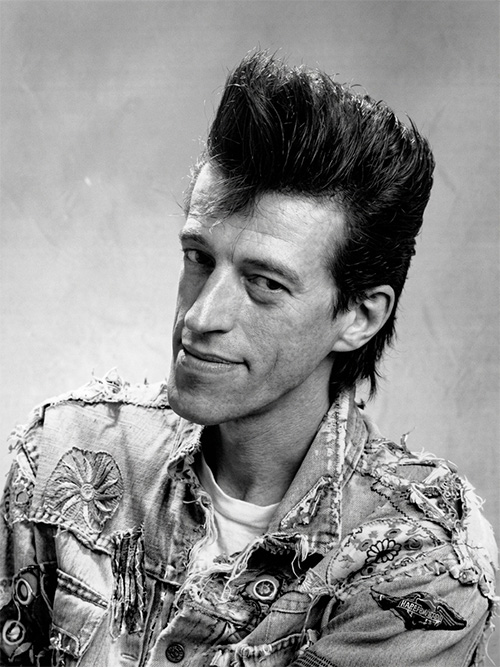
– You answered my question “How did you get to play with Paul Young?” before I even asked it. You had to scrub up nicely to be a part of that outfit, I assume?
Oh, I did scrub up nicely, but I was wearing the suits for THE VAMPIRE BATS too. There was a shop on King’s Road in London, in Chelsea, that specialized in these rockabilly-type suits that were very fashionable – everyone had them, people like Elvis Costello. They were peg-legged, and they had the jazzy stitching on everything, and that’s what I was into. And that’s what I was wearing in Paul’s band. It wasn’t a cheesy pop band; it was real, hard-hitting stuff, and it was a fantastic band live: me and Pino Palladino together, Paul dancing all over the stage, we had a Hammond organ and these two girls singing. We really went for it, and we’d come off every gig drenched in sweat. Paul had been in Q-TIPS but he got a record deal with CBS and got to do a solo album, “No Parlez”; it was nearly finished when I got a phone call from Paul, who got my number from Laurie.
He said, “There are three or four tracks that are not done yet, plus we need another song. And we’ve done some gigs without guitar, because my idea was to do it without the guitar player on the album, but then we realized that it would be good to have a guitarist in the band. That’s why I’m phoning you. Could you come up to a rehearsal?” So I went to North London to a rehearsal room – there were Pino, the drummer [Mark Pinder], and Paul and the organist [Ian Kewley] that was his long-term mate, and the two singers, Kim and Maz, THE FABULOUS WEALTHY TARTS – and I did my thing: a bit of feedback, a bit of soul rhythm. Paul said much later, “The reason I dug you straight away was your rhythm playing, when we did dance songs!” I was good at that Nile Rodgers-type thing, and I could go into Adrian Belew territory, and do the Hendrix thing, and then come into the rhythm.
And then he asked me, “Most of the tracks there are by other artists. Have you got any songs? We need a new one!” I said, “Funnily enough, I do!” I did have a cassette in my pocket of a song I wrote the night before. Someone lent me a Roland TR-808, so I got a groove going on this drum machine, and I wrote “Ku-Ku Kurama” from beginning to end. The reason it’s called “Ku-Ku Kurama” is, when I used to take my young boys to school, I passed a second-hand kitchen appliance shop called “Cooker Rama” and I thought of the John Lennon song “#9 Dream” where he sings, “böwakawa”: so I used that. People ask me, what does it mean – it doesn’t mean anything! Anyway, I gave Paul the cassette, and he phoned me back that same night, saying, “I love it. I want to do it!” I said, “You do?” – because it was a bit wacky, it was not a soul song. But we did it.
And the thing is, when you’ve played on a track and it’s mixed, the version that you hear on the record can sometimes be vastly different from what is actually on tape, but “Ku-Ku Kurama” sounded fantastic in the studio, when we played it back. Laurie did a great job. So out of nowhere, I’m in Paul Young’s THE ROYAL FAMILY band, and I’ve got a song on the album, and I play all around the country! CBS Records gave me money up front for the publishing, and I bought myself a car – not a new car, but a convertible Beetle – and a new family bed, and I’m still getting money from that song now. That’s when I realized that, to make any money in music business, you’ve got to write the songs.
– How was it hearing your song performed by that voice?
It was great. When Paul said he wanted to do it, and we did the backing track, with me on the Gretsch guitar, I thought he was going to treat it like a soul song and sing it like Wilson Pickett, but he copied my voice, so I was a bit disappointed. That was only my demo! Louise and me went to see Paul a couple of years ago, when he played here, around the corner from me; he had two girls sing it, and it was weird to hear my song performed by these other people. It was insane when we were recording “No Parlez”: we still had tracks to do, and I played on “Love Will Tear Us Apart” and on “Sex” and, of course, on my song, and there might have been something else. And we used to go to the pub every Thursday to watch “Top of the Pops” and we’d see what the chart position was. “Wherever I Lay My Hat” was going up, right to the top of the charts; then “Come Back And Stay” went right to Number One; and then it was like Beatlemania for Paul. We used to do gigs – we did Hammersmith Odeon – and we did a live TV on Christmas Eve that went all across the UK, live, we were live on the stereo radio, which was a big deal: and there were screaming girls and everything. And then we played every day around the world – every single day! – so it was a busy time.
– You’re credited with playing sitar on Young’s “Between Two Fires”: how many instruments do you play at all?
I only play guitar and a bit of harmonica, so that might have been sitar guitar. But I played steel guitar on “No Parlez” and I had a lap steel on a stand next to me on stage that I used.
– You mentioned Pino Palladino. Was it through him that you got into THE WHO camp?

Oh, that’s probably how he got there! I got into THE WHO before him, and that was a weird thing. I’d left THE PAUL YOUNG BAND the first time, and I was doing some demos in Sussex, and I had Pino play on them. So one day we were driving down the motorway, to the studio, when Pino said, “I was with Pete Townshend yesterday, working on his ‘White City’ album, and he was asking about you…” “He was asking about me?” “Yeah, he’s a big fan!” I said, “What? He’s a big fan of me? what do you mean?” Pino said, “Yeah, we were in the studio, and Pete asked about you, and then he jumped on the desk, in front of about eight people, and did an impersonation of your moves on stage!” I pulled the car over to the side of the road and turned around: “Excuse me? Say that again?” Pino repeated what he’d just told me, and that was it.
And then my phone rang: “Steve, it’s Pete Townsend here!” I went, “Yeah, right!” “No, don’t hang up, it really is Pete Townsend here. I just wanted to ask you a question: will you play guitar for THE WHO?” “But aren’t you the guitarist for THE WHO?” He said, “Yes, but I’ve got a hearing problem, and I need someone to be me. I’m going to play acoustic guitar, and I want someone to cover me on electric. There are only two people in the whole world I would consider for this job: one is Joe Walsh, and the other one is you.” I said, “Well, you can’t have Joe Walsh, can you? He’s American, and you can’t have an American in THE WHO!” He went, “Yeah, I guess you’re right. Look, I love what you do, and I see a version of me in you, with the hidden violence and the whole thing, when you’re playing, but I feel we should have some sort of audition. Can you come over tomorrow to Eel Pie Studios and bring an acoustic guitar?” I said, “Yeah…” – because I didn’t really play acoustic guitar then; to me it was like an instrument of torture, an instrument that you write songs on and then you fuck it off.
So I drive over to West London, thinking, “This is not me. How am I going to audition for Pete Townsend, playing an acoustic guitar?” And now we’re in the studio, and Pete goes, “I’ve got my own acoustic here, so we’re going to have a little play!” There’s a couple of minions hanging around, and he says to one of them, “Could you get the Gibson J-200 out of the storeroom, please?” This guy brings this case in the control room, where Pete and I are sat opposite each other, and when he opens the case, all the strings snap – all of them! – and the bridge, which is what they call it a moustache bridge, flies off. I say, “See, even the guitar smashes itself!” And Pete goes, “That’s that. You’ve got the job!”
– But where had he seen you, to be copying your moves,
He’d seen me with Paul Young quite a few times, apparently, doing live gigs on TV, and he’d come to a couple of concerts, so that was a stroke of luck. Rehearsing with THE WHO was a whole new story, a really stressful time – not because I couldn’t do it but because the amount of work was colossal. Pete said to me, “There’ll be a bunch of session musicians there, but don’t worry about them, and just do your thing!” But basically, I had to learn all the songs, about two hundred and fifty of them, including the whole of “Tommy” and some of “Quadrophenia” – like “Rough Boys” that I’d never heard before! I’m a huge fan of their first album, “My Generation” and maybe “Who’s Next” – but other than that, I knew nothing. And the thing about Pete’s songs is, they’re not they’re not blues-based, so you cannot jam along to them: you have to learn them, because they sound like written on piano, and there’s a different chord change of modulation every fourth bar, and it all changes, so you really have to have your wits about you. Fortunately, I can read sheet music and rhythm chart – well, I don’t read dots particularly but I can read chord symbols and repeat signs – and I’ve got hundreds of these all over the floor.
Pete said to me, “I want you to cover my ass, because myself, Roger and John are going to America for two or three weeks to do free tour publicity. We’re doing interviews and all that, so we’re not going to be there. There’s going to be a dep bass player, who’s also the MD…” It turned out he didn’t like me and he wanted to get his friend in, so I was getting it from all directions. Pete also said, “Oh, and there’s one other thing: you can’t play loud – you’ve got to be really, really quiet.” I’m thinking, “Right. So this is THE WHO, the world’s loudest band, and I’m being told I’ve got to be really quiet!” I’m not talking like thirty-watt amp – we were investigating custom amps that were as big as a little transistor radio. It was ridiculous! At one point, we were rehearsing, with Rabbit [Bundrick] on keyboards and Simon Phillips on drums, and I was using Mesa/Boogie amps that were this big (shows with both arms), and I had it really quiet, but Pete came to a rehearsal, because he had a couple of days off, and went over to me: “Can I have a word with you?” He took me in the back room and said, “You can’t play that loud,” and I went, “But it’s not loud!” He said, “I know but you can’t play that loud because I’ve got tinnitus!” He was really paranoid about it. By the time of the first show I had speakers the size of that wall, six Mesa/Boogie cabinets and three one-hundred-watt heads, and in the middle, behind Roger, another two double-stack cabinets – and I still couldn’t hear what I was playing because of the Ox! It was crazy!

I was living in South East London, and the rehearsals started off in West London, at Nomad studio, in the big room which became much smaller because we had all this gear, so on my drive over there I had a box of cassettes to familiarize myself with these songs. I get there, and the first person from THE WHO to arrive is John Entwistle: he comes in (imitates bass rumble), and it’s like, “Whoa, okay!” And now I’m able to crank my guitar amp because he has this massive bass rig and he’s super loud! No one’s told him he’s got to be quiet! (Laughs.) Then Roger Daltrey comes in, strips to the waist, and goes, “If anyone if anyone gets caught with drugs…” – he’s throwing his weight around. But on the third day, after we’ve rehearsed without him, Pete Townshend is there, and immediately he’s the boss, and I see the dynamic there, because Roger becomes a bit subservient. That’s why I’ve been interested in this recent situation with Zak Starkey – I’ve been watching this with a smile on my face.
Anyway, Pete’s in there, and the road crew have built, in the far corner of this rehearsal room, a kind of Wendy house out of sound screens with a window, a bit like a studio booth, to protect him, and he’s got little domestic speakers on the wall and his acoustic guitar, so everyone’s around here and, right diagonally across the room from me, is Pete in his garden shed. He’s meeting with all these publishing and managerial people, and one of them comes around and says, “Pete would like the band to run over the overture from ‘Tommy’.” But an overture is a bit of everything put into a package at the front of an opera, and this overture’s about six or seven minutes long, and it’s got a famous section of “Pinball Wizard” in it (sings the tune), only it’s in a different key – in G instead of B – and it goes on for about sixteen bars, so this is like a rhythm guitar part.
So we’ve all got our heads down, looking at the music, and it comes to that bit, and I stop playing because Pete’s supposed to do that – that’s an acoustic guitar bit – but he doesn’t. I look across the room, and he’s in there but he’s got his arms folded, and he’s looking daggers at me, glaring at me like that codfish. So I start playing it, and the minute I start playing it, it’s: “Stop! Stop!” Everyone stops, and I’m thinking, “Oh shit!” He gets the guitar he’s got, smashes it into bits on the floor, kicks the walls of this booth and walks over to me, getting right in my face. Of course, at that moment, I haven’t got a friend in the room: everyone’s picking their noses or whatever. And Pete says, “What the fuck are you doing? That’s my bit. Leave me something to do for Christ’s sake!” I thought about this really quickly and I decided, “Well, I’m not going to let him walk over me!” I pulled him even closer, face to face, and said, “Yes, I know, but you haven’t been here, so I covered for you, as you told me: I covered all the bits I thought you were going to do. But now that you’re here, I stopped when It came to that bit, but since you had your arms folded over the guitar, so I joined in again!” You know what he replied? “It’s my band. I can do what the hell I like!” In that moment, I knew where I was at and where he was at. Weird, as we all are. It was quite funny. (Laughs.)
– How were you treated by the rest of the band – like a hired hand or like a professional colleague?
It was hard to read Roger and John them, they’d been doing that even then for so long. John was fine – we used to look at each other on stage and smile, and he’d invite me up to his suite afterwards for Club Max. Max was the name of his girlfriend at the time, so we’d go up there and (enunciates) partay. But Roger was a man unto himself. I don’t know how much I can tell here, but there was a moment when Roger came up to me on the private plane and said, “Boltz, we’ve got a problem here. You’re on John’s side of the stage, and it’s like LED ZEPPELIN. And on Pete’s side of the stage, it’s like Crosby, Sills and Nash…” I went, “…and Young?” He said, “Yeah, and Young. So I’m leaving it up to you to tell the Ox he’s got to turn down.” I said, “Excuse me?” And he repeated, “I’m leaving it up to you to tell John he’s got to turn down. It’s too loud!” I thought, “Right…”
Later that evening, before the show, I was in the dressing room with Simon, when Pete came in. “Everyone good? Everything good?” he asked. I said, “It’s all right, but the singer…” Pete went, “Oh, what’s he done now?” I explained the situation, and Pete said, “He’s always been like that. Tell him to fuck off!” And I thought, “Now not only have I got to tell John Entwistle that he’s got to turn down but also to tell Roger Daltrey to fuck off? All fun and games!”
– How was it playing with Simon Phillips?
Simon is, obviously, a top drummer, a perfectionist. Simon was great. And we had Rabbit on keyboards, John Bundrick, also a great player, but a bit of a wild man. He would come into hotel rooms completely pissed and threw his weight around, and I’d say, “I’ve got friends in here, chatting, so could you leave my room now?” And he went, “God damn it! All right then. As Jerry Lee Lewis said, ‘Never mind’!” I asked, “Did he?” And he replied, “I don’t know…” (Laughs.)
– Were those the biggest concerts of your career?
Yeah, absolutely. They were usually in football stadiums, American football stadiums, anywhere between sixty and eighty thousand people, in tiers, and the whole pitch had seats in it too. It was a weird thing, though: you’d see people that were there for every gig, and every night they’d go, “Steve, how are you?” It was insane!
– Not intimidating?
No, no. Because we had duplicate equipment – amps, drums, everything – the stage was always the same. When you play on a smaller level, every time you do a gig, it’s a different size stage; but when you’re on these super gigs, it’s always the same size because they transport all this stuff by road. They leapfrog, so it was quite an operation! But I became very friendly with THE WHO’s manager, Bill Curbishley, and I still speak to him occasionally. This East End geezer would always hit my side of the stage when I was doing my thing, and he’d be going, “Boltz, smash it! Smash it!” And I’d be hitting my amp with the guitar, but I wouldn’t smash it: I’m not that insane, and my guitar is very precious to me.
– You also played the “Tommy” show with special guests: Elton John, Billy Idol, Phil Collins. How do you remember that?

When we started off doing gigs, we would do a few songs from “Tommy” – but not the whole rock opera, and the first time we did it entirely was in New York, at Radio City, without any special guests. Before I got the job, I’d been working in London with an American called Max Gelt, and we recorded a heavy metal album, “…And God Gave Us Max,” with a few guys, including [Jan Cyrka] from ZODIAC MIMDWARP. Max was a crazy man, who’d done pornography for a glossy magazine. He looked fantastic in the gold lamé suit on the front cover of that album, but some of the songs were… The verse in “Almighty Dollar” went, “I’ve seen Buddha, I’ve seen Gita / Now I just want what’s in the parking meter”: great stuff!
Anyway, when I got the gig, Max was back in New York State or Pennsylvania, so he phoned me up during production rehearsals in upstate New York and he came to my hotel; I got him passes for Radio City, we had a drink, and he said, “Man, you know that bit where Roger goes, ‘See me, feel me, touch me’? When he does that, I’m going to stand up, point at you on the stage, and go, ‘I know him, he’s my friend!'” And I’m thinking, “He fucking will!” When we got to Radio City after about two weeks of touring, everyone’s there: Jackie Onassis, the Mayor of New York and other dignitaries, all watching the show. We do a few songs, and then the whole of “Tommy” – and when we came to that bit, I was sweating: I thought, “He better not do it! He’s going to do it, isn’t he?” So the lights go green, and it’s just me on the guitar, and Roger singing, (raises hands, imitating Daltrey, and sings) “See me, feel me…” And you know what, Max didn’t do it! (Laughs.)
Later on, we played in Los Angeles, at the Universal Amphitheatre, with all the guests, which was quite something as well. Pete came up to me a few gigs before that show and said that he’d had a message from Elton about “Pinball Wizard”: “Elton had been playing it at home, and his voice has changed over the years, so he’d like to change the key of it.” I immediately went, “What? You can’t change the key!” You see, it’s all written on guitar, and if you change the key, all the inversions are different, and it doesn’t sound right. Pete said, “I know, I know. It’s weird, but that’s what he wants to do. He wants to do it in G!” So I ran over it, thinking it was going to sound really odd.
It’s probably bullshit, but Elton did not make the dress rehearsal with all the other guests – Billy Idol, Stevie Winwood, Phil Collins – so the first time that he sang “Pinball Wizard” in the new key was when it went out nationwide on HBO. He starts singing, and it’s like this: (sings, with each new line lower and lower) “Ever since I was a young boy, I’ve played the silver ball / From Soho down to Brighton, I must’ve played ’em all / But I ain’t seen nothing like him in any amusement…” And Pete’s looking across the mic line at me (cover his mouth with his hand and grins), because that’s right up his street when anything’s a bit weird and wrong, a bit like John Otway. That was funny, but it was good. Then we did it back in the UK, at the Albert Hall, also with Billy and Stevie, so it was quite something to do that WHO show.
– There was another prominent gig of yours, much later. You played with Lemmy on “Later… with Jools Holland”: how did that happen?
Oh, well, I kind of knew Jools Holland: I lived not far from him in South East London and I’d worked in his studio. When he was the band leader on the “Don’t Forget Your Toothbrush” programme, where the audience turned up with their passports, prepared to be whisked off anywhere in the world, they had guest musical artists, so I got a phone call from him. “We’ve got Roger Daltrey on next week,” he said. “You know Roger, and I need somebody with a large guitar. Would you be up for doing that?” I went, “Absolutely!” This programme went out live on Friday night, at six o’clock, and on the Thursday before the gig, a motorcycle courier brought over a cassette of songs that these artists wanted to do. Roger wanted to do “Iron Man” or something like that, and it went well, so Jools phoned me up a few times after that, and one of those times was about Lemmy.
As usual I received a cassette and put in on in my kitchen: one of the tracks was “Good Golly Miss Molly” and the other one, “Ace Of Spades” – a great song! I played along with it, and I thought it was in the key of E, which is good for a guitar, with open strings and stuff, but it turned out to be in E flat. I thought, “Why?” I didn’t realize that they detuned a whole half-step. Usually, on Friday morning, we’d go to a rehearsal room near Tower Bridge, play down there for a few hours with the artist, and then decamp over to the TV studios. So with Lemmy, I get to the rehearsal at ten o’clock – his roadies are there, and all the gear’s set up: he’s got this massive Marshall stack and the Rickenbacker bass – but I’m not detuning my Strat because it’s got floating tremolos, so I actually play it in E flat. Before I know it, Lemmy’s got a pint glass of “Jack Daniels” and “Coke”: “Do you want some?” I say, “No, it’s a bit early for me!” (Laughs.)
The funny thing is that, back in the Seventies, Lemmy was always hanging around in The Speakeasy, and he told me then, “I’m forming a band and I want you to be in it!” But we all knew him from HAWKWIND, so I just ignored him, and it was probably for the best, because if I joined MOTÖRHEAD I would have been dead, probably. It would have been good fun, though, wouldn’t it? I did meet Fast Eddie [Clarke] once, in his flat in Putney, and he was a bit of a basket case: I think that you can’t do that and not do all that speed and whatever else they were doing all the time.
– We mentioned Pino Palladino earlier. You were on Rick Wright’s “Broken China” with him, right?
Yeah, I played rhythm guitar on a couple of tracks on that album. The producer [Laurie Latham] phoned me, and I went over to Dave Gilmour’s barge on the Thames, where he had recording equipment, but I didn’t actually meet Rick – that’s how it happened in the Nineties.
– Was that how it happened with Trisha Yearwood’s “Walkaway Joe”?
That name rings a bell, but I don’t remember much about that.
– What about William Sheller’s “Albion”?
Right, okay, I can talk about this one. This is probably the best thing, guitar-wise, I’ve ever done, the best! I got a call from Dave Ruffy, a really heavy drummer who was in a band called THE RUTS and then THE RUTS D.C. He told me about this composer, William Sheller, who is a huge name in France: a full-blown classical pianist but with a crossover into easy-listening pop. William wanted to do a psychedelic-rock album, and he’d asked the producer, Mark Wallace, to come up with three guys, so Mark got in touch with Dave, and Dave got in touch with me. – I said, “Yeah, sure!” – and Gary Tibbs who worked with Brian Ferry a lot, a great bass player.
We went down to a residential studio in East Sussex, in the countryside, where we met Sheller, a very shy guy, who wrote all the complicated music on his laptop. We did one trial track and played it back in the studio, and he went, “I like it very much!” So we knew we had the gig to do the whole album, which we did for about six months, because there was money from the record company to pay for the studio time. In the end, the record company hated the album, but it’s actually a bit of a masterpiece. We recorded live, and I had a whole room with a selection of amps, all linked up, and the producer got me the best guitar sounds ever. It was quite unbelievable! My final shot to William when I left was, “Thanks to you, I played every single note on my guitar!” (Laughs)
– I guess another pair of unusual albums for you had to be Nic Potter’s “Mountain Music” and “Sketches In Sound”?
He was a lovely guy, Nic, a bit odd but great. Nic was vegetarian as I am, but he wouldn’t let anyone in the house – a flat near King’s Cross, in London – if they’d been eating meat. He’d have to smell them and wouldn’t let them in, so they’d have to stand on the balcony. I don’t really remember how we recorded that stuff, though, it slipped my mind as things do.
– You also worked on Ray Davies’s “Other People’s Life”: how did that happen?
At the time, I was living in Greenwich in South East London, but I rented a cottage in Suffolk, and I was doing a solo album there, that never got released, and I don’t know how that happened, but I got this job with Ray. When I told somebody, a friend, about it, he said, “Oh, Ray Davies, watch out with him. He’s got a bit of a sharp tongue, and he’s a bit of a weird guy to get along with!” But we got along really well. Same thing, he’s vegetarian, so I’d drive from Suffolk into the studio in Crouch End, and he’d meet me at the door with vegetarian biscuits, saying, “Steve, have you tried these?” There were Norman Watt-Roy from THE BLOCKHEADS on bass, Dylan Howe, Steve’s son, on drums, and me. Then, one day I was doing overdubs, Ray did come in the studio after we’d done the backing tracks and everyone else had gone home…
That’s the thing with being a guitar player: you have to be there to record the backing tracks, and then they take your guitar off, because it’s probably full of mistakes or they haven’t got proper sound, and you have to be there for another couple of weeks to do all the parts again, but you’re still getting the same pay as the people that have just gone and played. Ray was good. I ran into him about five years ago on Euston Station; I was with Louise, and he came over and said, “Hey, how are you, darling?” I really like him. Oh, yeah, one other thing, something I told him about. When I was about fourteen, living with my mum and dad, non-musical family, we had a small black-and-white TV, and THE KINKS were on, doing “You Really Got Me”… And just before the guitar solo, Ray leaned back, came right to the screen and went, “Oh, no!” And my dad said, “What the bloody hell, sir? What’s that?” He freaked my dad out, that guy with long hair! I told Ray that story, and he went, “That’s nice, Steve, thank you!” (Laughs.)
– You released an album called “Live In Studio” a few years ago, the only record under your own name. So tell me about your solo career, please.
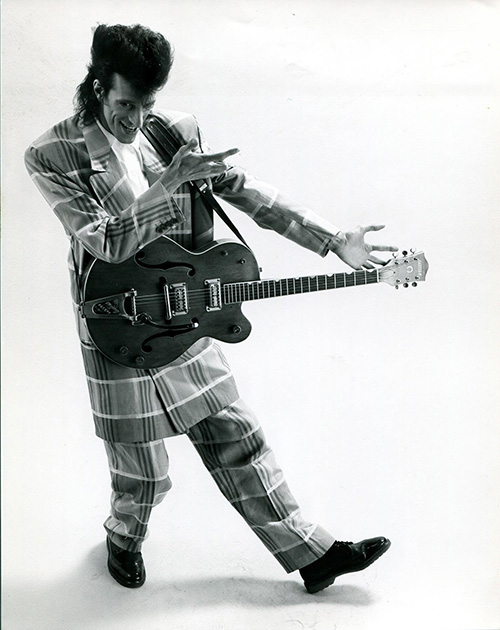
I didn’t have a solo career! When my parents died, they left me a bit of money, so I bought some new equipment, including this Yamaha workstation. I was living in London, but I rented a cottage up in Suffolk, in the country, and I decided to try and do a solo album, and then it morphed into DEAD MAN’S CORNER. But then I started doing acoustic gigs on my own, something that I never used to do. I did the first one as an experiment. (Laughs.) In the middle of Greenwich, there was an arts-and-crafts market, with the traffic that went right the way around it, so I decided to go in there one day with a steel guitar. There was a sign, “No busking!” – but I got the guitar out and started playing songs. I had played in a covers band, so I had a certain amount of songs, and people started giving me money! Within one hour, I had fifty pounds cash in my pocket. This was like a Damascus. like a revelation to me. I thought this was fantastic, because, as a musician, like actors, you sit by the phone, waiting for it to ring, for other people to tell you when you can earn money.
That gave me the confidence to start looking for solo gigs, but then I formed the band – this was about the time when I met Louise – and we were playing pubs and clubs, doing covers. Not that I felt we should not be doing that, but there was always something in the back of my head that I wanted to do my own songs, and that’s how DEAD MAN’S CORNER Mark I was born. Being a bit perverted, I always envisaged it as a David Lynch movie, where everything appears kind of normal, but the more you look at it the more you realize that this is not normal, that this is a bit odd. Rather than be overtly psychedelic, for want of a better term, to be a bit left of center. I had a pedal steel too – I’ve no longer got it – and it’s a really complicated instrument, so to play it you have to be like a brain surgeon, and every time I tried to learn it, I was, “I got it! No, I ain’t got it! I got it! No, I ain’t got it!” (Laughs.) Anyway, my vision was to put a pedal steel in an inappropriate situation, because its sound immediately makes you think it’s country-and-western – but it wasn’t country-and-western. My songs are a bit weird, so I would put it in those, so that was my vision for the band. I thought we were going to set the world on fire.
Sure enough, we did gigs and people just looked at us like we were making Martian music or something, and it’s difficult because as a creative musician, you always appear to be one step ahead of the audience, but the audience wants to hear things they’re familiar with. I was sat in my garden here recently, and on a Saturday and Sunday I hear the music coming up from the harbor that we have down there, over the hills, and every band that I hear is playing popular rock covers, THE KILLERS and such – that’s what people want to hear! But that’s not what I want to do, particularly. I do covers when I do solo stuff, but not with my band. I can’t understand why people don’t want to hear original music! DEAD MAN’S CORNER went through about four different versions, and for the last two years, I had the perfect band, but anyway I’m busy with ATOMIC ROOSTER now.
Just recently, we’ve been in the studio again in the north of England, and recorded six new tunes with another four ready to be done to. So all my creative energy is going into writing new material. It’s good, because it’s like having a brief: if you’re left to your own devices writing songs, it’s tricky, but with ATOMIC ROOSTER there’s got to – be a certain, I wouldn’t say formula, but it’s got to be in a certain genre. We were thinking, “Should we do four or five tracks and release it as an EP?” – but it’s all sounding so great that it’s going to be an album next year, again on Cherry Red. It’s up to us, though, to provide the mixed tracks, and we’re paying for the recording ourselves.
As for the “Live In Studio album, no, I haven’t released any solo records, but I know what that may be. I did some gigs in Italy, and the guy who got me those had me go in a studio in Rome to record so he could concoct a disc to sell at concerts as merchandise. It was all done in a couple of hours.
– So you’ve never dreamed of doing a proper solo album?
No, but I think I’m going to now. I think that’s my next thing, and I’m all set up here. I’ll tell you what provoked it. After DEAD MAN’S CORNER, I was in bereavement, because that was my baby. It was all my songs played by the band. So I thought, well, the trouble with bands is that you’re relying on other people, and then they want to get gigs, and so on. What I’m going to do is record some stuff here.(Shows at the studio set-up behind him.) I’m getting pretty good at programming drums and stuff like that. so it’s going to be a mixture of groovy stuff with Hendrix guitars and lots of twang – and lots of everything I’m into, like THE BEATLES and SLY AND THE FAMILY STONE, all mixed together. We’ll see what happens.
– With all your adventures, what would you call the highest point of your career? And I don’t mean getting high.
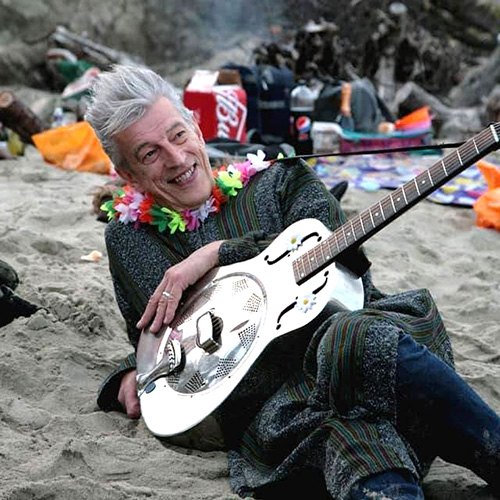
I’ve done lots of things that are memorable, but on the first gig I did with THE WHO in a huge football stadium, about ninety-thousand people, when everyone had cigarette lighters out, I stood next to John Entwistle. I looked at him and he winked at me, and I winked at him, and I thought, “Shit, this is really bizarre! How the fuck did this happen?” That was the highest point – but at the same time, I thought, “I can’t go any further than this working for other people. So I’ve really got, before I die, Ito do something for myself!” All the stuff with all the bands, I’m proud of it, and I’m proud of the songs I’m writing for ROOSTER, but it would be good to release a solo album. It will be original. So hopefully this time next year, we can talk, and I will have it in the can.

