


Island 1970 / Panegyric 2025
Taking the “difficult second album” syndrome to a whole different level, a record that set future prog titans on a course of perpetual transmogrification sees its secrets unsealed.
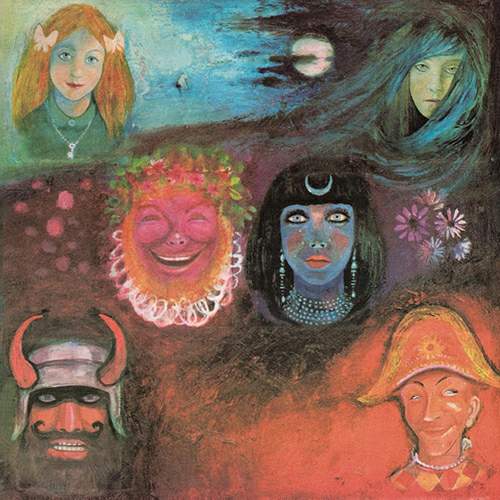
In The Wake Of Poseidon
Often perceived as a less sinister twin of "In The Court Of The Crimson King" which had seen the light of day sevens months earlier, “In The Wake Of Poseidon” could signal the end of this British ensemble; instead, it became a testament to Robert Fripp and Pete Sinfield’s perseverance and to dispensability of any player apart from the leader. Finding similarities between the collective’s debut and sophomore effort is easy, yet to approach the latter in such a way would mean to significantly simplify what the musicians behind it came up with in the face of adversity. “Adversity” may not be the best word, however, to refer to the group’s disintegration following the departure of reedman Ian McDonald, who wrote the bulk of the combo’s inaugural album, drummer Michael Giles, and singer Greg Lake.
The last two agreed to help salvage the ship they were to abandon by temporarily staying on board and assisting in laying down (over the course of five sessions, fully documented on Blu-ray in the 50th Anniversary two-disc package) fresh material, which partially dated back to the team’s formative period – some, with McDonald’s ideas in its core, to CRIMSO’s recent tour, some to the jolly old days of GILES, GILES AND FRIPP – and partially was composed specifically for this record. One of those new cuts is “Cat Food”: the ensemble’s solitary stab at commerciality that landed them a spot on “Top Of The Pops” and sounded as a far cry from the apocalyptic gloom the two titular words seemed to welcome on “21st Century Schizoid Man” on the predecessor of “Poseidon” – even though not a lot of listeners appreciated the irony of “foot” turning into “food” and moving the album up the charts. The original darkness never went away, of course, and “The Devil’s Triangle” – the group’s first standalone studio instrumental and the platter’s sole wordless piece – brings the infamous tritone to the surface quite impressively, in a symphonic bolero manner, albeit without the menace "Larks would offer further down the line. More so, the swinging and rocking “Pictures Of A City” crystallizes, in riff-driven surges and chops propelled forward by Peter Giles’s bass, the urban danger "Red" would focus on before the collective’s initial lifespan folded in the mid-’70s.
Not for nothing these two numbers – slotted, respectively, in a second-to-last and second from the start positions – sit next to the tranquil “Peace” which directs the record’s sonic dynamics to delirium, and Steven Wilson‘s 2025 reframing of the classic will take the drops in amplitude to the extreme, especially when streamed into the ether, rather than accessed via headphones. There’s a sense of disaster setting in after the spatial a cappella poise of “Peace – A Beginning” is destructed by Fripp’s six-string assault and the onslaught of Mel Collins’s saxes that are tamed in David Singleton’s Elemental mixes to concentrate on the music’s mood as well as details buried in the overall aural image. And then, there’s a feeling of bliss unraveling once the serene “Peace – An End” replaces almost catastrophic shifts of the sprawling satanic interval, whereas “Peace – A Theme” dispenses with lyrics in favor of a faux-flamenco acoustic strum, also emerging in the behind-the-veil delving into the album’s title epic whose heavy beauty and rippling passages mesmerize and excite in equal measure. But while the gentle, flute-flaunting “Cadence And Cascade” fleshes out Robert’s melodic romanticism with guesting Gordon Haskell’s vocals very effectively, the recently discovered Lake’s voicing of the track, added here as one of a few bonuses, comes across as much warmer – and thus, slightly counterproductive to the platter’s handling of mystique subjects, and splashes of Keith Tippett’s ivories, the same jazzy piano elevating “Cat Food” to the heights of transcendental levity, add a whiff of smoldering to the ballad.
Still, “Groon” – justifiably relegated to a single B-side – marries groovy merriment to experimental intent with a lot of audacity, demonstrates how compromise failed to enter the ensemble’s performative vernacular, be it within prog or fusion format, and emphasizes the importance of that period in the band’s history. Less sinister twin? Perhaps – yet in terms of balance “In The Wake Of Poseidon” is as close to perfection as circumstances allowed: thriving in chaos morphed into art on this record, and "Lizard" – which arrived in another seven months – molded chaos into spiritual adventure.
****3/4


