


Talking Elephant 2026
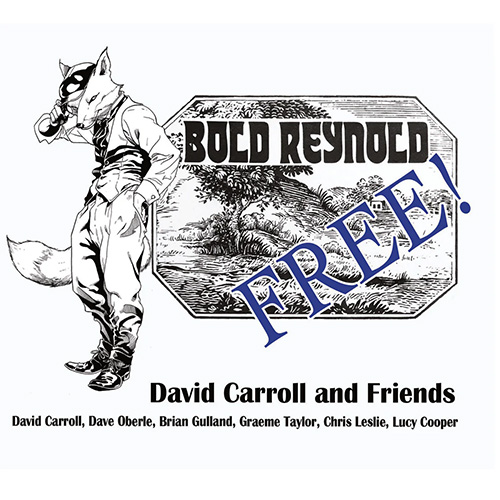
Scoring a hat-trick and tipping their hats to legends of yore, veterans of British folk rock reach for the ultimate liberty of expression.
It’s easy to be a cynic and suggest one’s second album carries forward a momentum, if not a surplus of songs, from their first platter, yet to think so would mean to grossly ignore the “F”-word adorning the covers of BOLD REYNOLD records: “Friends” – although there’s also “Free” now to further the pun of "Too" for another country mile. Just like the collective’s self-titled debut from 2022, the numbers David Carroll and his coterie reimagine for the modern age emerge from the folks’ informal gatherings, rather than brainstorming studio sessions, with GRYPHON and FAIRPORT CONVENTION members clued into such material in any case, and rural telepathy is manifested here time and time again.
However, this time the ensemble’s focus shifted to expansive storytelling and, thus, longer pieces, three of which take up more than half of the disc on display, and while its predecessor often demonstrated an in-your-face attitude, that “Free” will be different is apparent from the very start. When “Sweet Jenny Of The Moor” launches the band’s musical raft towards the past in a mid-tempo manner, the listeners are placed right in the middle of things and are apt to observe the proceedings quite raptly. Here’s the reason why, as the chthonic drones of Brian Gulland’s harmonium and Hammond get embroidered with Carroll’s pipes and voice, strands of homespun magic, accentuated by Graeme Taylor’s gentle guitar twang and Dave Oberlé’s delicate drumming, descend from the ether to engulf the audience in timelessness. They may go for an infectious sea-shanty sway in “Hanging Johnny” that bass and bassoon anchor to rock bottom, and sharp riffs direct choral refrains to the highly charged electric lines “Well Sold The Cow” exposes too, but shorter cuts – including the under-two-minute “What Will We Do When We’ll Have No Money?” which locates the band in a communal spirit near the proverbial fire – seem to serve as a catchy contrast to four mini-epics, coming in pairs to ensnare the aural spectator.
Unusually for this project, “I Will Put My Ship In Order” floats a long instrumental intro, with Chris Leslie’s fiddle applying oodles of restrained sentiments to David’s acoustic strum before dissolving them in a robust ballad, where Lucy Cooper’s vocals join in to soften the tune’s dramatic blow and then lead the troupe into the sprawling tragedy of “Molly Bawn” – whose dry sounds are slowly wetted with tears the musicians’ passages form. As mandolin and harpsichord add medieval elegance to “Down By Mount Callan Side” that, for once, resolves in a happy ending, its warmth permeating Carroll and his merry men’s impassioned delivery, the album’s mood and tack slightly change, so the woodwind-flaunting and a-cappella-taunting “The Hunt Is Up” comes across as groovily invigorating. Still, if “The Female Transport” has a lot of exotica in its percussive heart, bouzouki and oud spicing up the arresting tale of Sarah Collins – one of several names strewn over the record – “The Parting Glass” doesn’t hurry to show the full dynamic scope of its wondrously sorrowful fatigue, setting the scene for the solemn, Oberlé-sung “No Man’s Land,” which will offer no solace, yet a lot of sympathy for those fallen in wars, in order to say farewell.
With this serious opus BOLD REYNOLD revealed the other side of their reveling in the past, and it’s an important part of the ensemble’s progress. If their “Fore” – or “For”? – will be more emotionally balanced, the project’s journey will be complete.
****3/4


