


MoonJune 2026
Righting the wrongs of the past, blistering performances from the States find jazz-proggers at the top of their game.
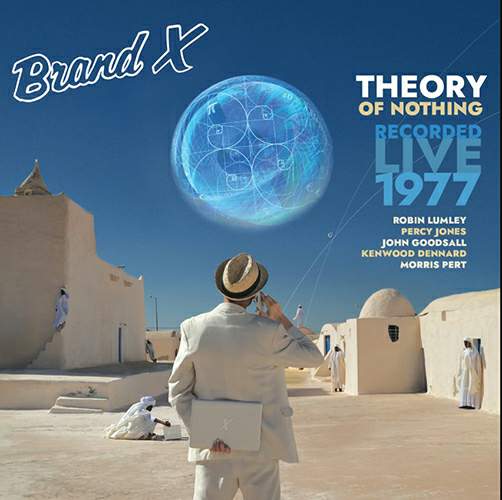
Theory Of Nothing
Ardently revered yet criminally underrated, BRAND X arrived on the fusion scene a little later than RETURN TO FOREVER, MAHAVISHNU ORCHESTRA and WEATHER REPORT, and they came from a different place – both cerebrally and geographically – than those ensembles. Always rocking as if there was no tomorrow, but never adopting an in-your-face stance, despite being just as virtuosic as their American counterparts, the pieces Percy Jones, John Goodsall and Robin Lumley composed reflected their Britishness in the studio and onstage, which made the band an arresting proposition, especially in front of an audience. Unfortunately, the rare concert recordings like "Live At The Roxy LA" didn’t bring the musicians any royalties, while 1977’s “Livestock” didn’t expose the entire scope of their spectacle, and that’s why the discovery of the collective’s tapes from the same year has an immense historic, and sentimental, value.
Found in Lumley’s attic after his passing and prepared for release by Jones, it will finally restore financial justice and give fans a proper set to marvel at the group’s creative freedom, because the numbers gathered on “Theory Of Nothing” – sourced mostly from Chicago’s Aragon Ballroom, where they played on November 11th, shortly before “Livestock” was issued – were supposed to promote this offering, rather than the earlier pair of platters. As a result, the quintet were able to build on improvs and take it all much further, up to introducing three cuts which would officially appear on “Masques” a year later, when the line-up changed and original magic somewhat weakened. Here, however, the collective charge ahead, from the finely condensed “Smacks Of Euphoric Hysteria” that exquisitely demonstrates the artists’ telepathic rapport, to a fantastic rendition of “Nightmare Patrol” that lets them finish the show in a triumphant manner, with a series of nuanced, if understated, flourishes which focus on the tight-but-loose grooves of Kenwood Dennard’s drums and Morris Pert’s percussion as much as they do on the melodic trio’s lines.
It’s the intricate rhythms, though, that fuel Percy’s bass and John’s guitar, alternately bringing their weave to the fore and supporting Robin’s synthesizers, on “Disco Suicide” – whose fun is impossible to suppress, with dynamic swells and falls working on a guttural level – and allowing the band to indulge in the yet-unheard “Access To Data” – which relies on the ivories to produce a pop sheen. They seem less reserved on the expansive, tempo-shifting “Why Should I Lend You Mine (When You’ve Broken Yours Off Already)?” – but there’s a lot of space for Goodsall’s filigree and Jones’s sophisticated rumble to marry medieval melodies to modern riffs and even subtly draw on reggae for Lumley to go on many a sublime tangent. As the effervescent “Euthanasia Waltz” applies adventurous twists and turns to its cosmic romanticism and sees Mini-Moog and Fender Precision reign supreme, never overshadowing the filigree peeled off the Strat’s fretboard, and the streamlined, Latino-tinged “Malaga Virgen” picks up the pace to become a blistering exhibit of the combo’s mastery of speed and provide the ground for solo passages and ensemble work, and then slows down to blissful balladry, the sense of awe settles in.
Not coincidentally, this moment was chosen to invite the listener to partake in the still-to-be-preserved pair of “Earth Dance” – a Saratoga tango, as the musicians call it – and “Deadly Nightshade”: the fresh tunes feel unfettered and more immediate, albeit no less detailed, than their final versions, which replaced Lumley’s delicate touch with J. Peter Robinson’s punchier one, and saw Goodsall and Jones up their brilliant, blinding sonic assault. To hear the future classics in early form outside of bootlegs is akin to a revelation, and of course, such an approach required the new entries in the group’s catalogue to be followed by “Nuclear Burn” – what else? – that’s indeed scorching in its forays into the great unknown.
With justice served on several fronts, “Theory Of Nothing” is a document to measure a fleeting existence against.
*****

