


MVD 2026
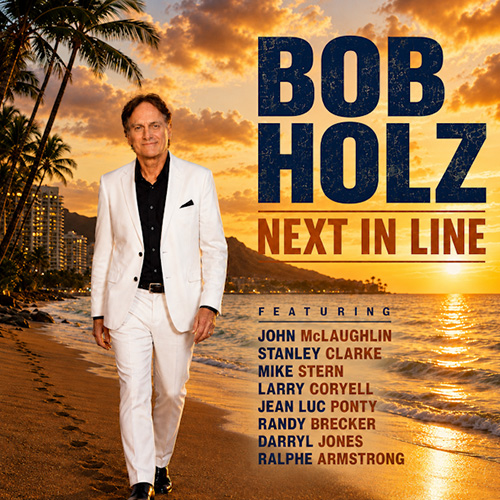
Next In Line
American veteran of fusion dialogue locates his fire in tuneful conversations with his friends of some renown.
Coming from the Tony Williams and Billy Cobham school of band leadership, Bob Holz knows all too well how to call the shots from behind in an unobtrusive fashion and go for a rimshot only when numbers require an explosive sound. This is why, while his records are strewn with performances from stellar guests, it’s always the American skin-hitter and his co-writer, keyboard wizard Bill Steinway, that direct the spectacular coterie. Sometimes, such interplays are the gist of the Los Angeleno’s approach to arrangements, as albums like "Holz-Stathis: Collaborative" suggest in style, and the ten cuts of “Next In Line” provide an array of his rhythmic exchanges with stars who keep their egos in check to serve a melody on display: hence the platter’s title.
And it couldn’t work any other way on the delicate, deliciously vibrant “Larry’s Blues” that builds momentum on a Gershwin figure and finds Mike Stern and Randy Brecker assisting the cymbals-rustling and toms-thumping Holz in paying homage to his former employer Coryell, whose own tangent-exploring, merrily unbridled licks, abetted by Steve Weingart’s cosmic ivories, drive the effervescent “Shooting Range” to the edge of the purest jazzy delirium. One may rejoice even more in “World Turned Upside Down” that reunites John McLaughlin, Jean-Luc Ponty and Ralphe Armstrong after a separation of nigh on half a century to engage them in a slow, sparse swirl of finely ordered frequencies which Bob’s simple beats commandeer. Still, his love of fun and unwillingness to conform to the fusion norm become quite apparent from the start, when Alex Machacek and Stanley Clarke go for the sweet whiff of reggae in the remix of “Jammin Man” that opens this disc.
Holz’s grooves spur the tone-shifting funky dance of Armstrong’s bass and Stern’s guitar on the brass-splashed “Silverthorne” before assuming light complexity and letting Brecker take the mood a notch higher only to have “Moving Eyes” pan across the aural shore with the uncredited Tori Higley’s sultry vocalese and bring things to a close. If this comp’s cover artwork, which serves as an illustration of its finale, was less generic and latched on instead to “Better Try” where Darryl Jones and Dean Brown wax romantically, or even “Eleven High” where Bob eventually unleashes a drum solo, “Next In Line” would feel perfect – but then, it is perfect anyway.
*****

