


Think Like A Key Music 2026
Too ’60s for the ’70s: Los Angeles ensemble’s legend-setting years outlined in their entirety.
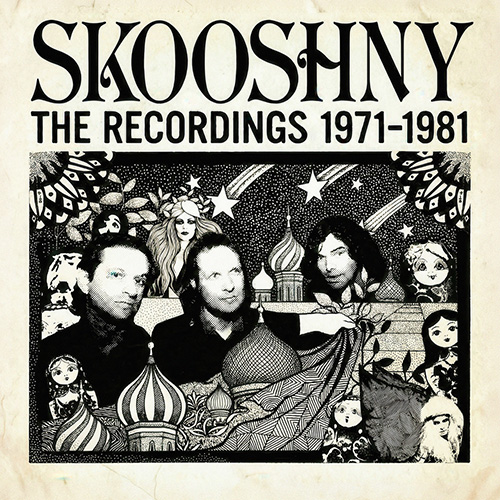
The Recordings
1971-1981
Formed in Chicago and taken west yet paradoxically sharing southern DNA with BIG STAR, whom connoisseurs compared them to, SKOOSHNY never let the penchant for turning professional get in the way of the band’s creativity. Having issued a sole four-song EP in 1978, the Californian foursome seemed destined to be forgotten until their Anglophilia fell on grateful ears in the UK a quarter-century after Mark Breyer and David Winogrond had started out in an Illinois combo called BREVITY. Overseas collectors’ demand for that platter resulted in the group’s proper album-releasing career in the ’90s – if, of course, a studio-only existence can be dubbed a proper career, although life on stage never felt too alluring for them. The reluctance to tour contributed to various labels’ initial interest and subsequent indifference to a slew of ditties Breyer wrote and Winogrond arranged during their first decade, but those tapes stood the test of time – at least melodically and lyrically – and there’s much more than simply historical value to this compilation of everything recorded then.
Here’s why the title of the number which opens it – and which served as the titular cut of the band’s inaugural record – is so fitting, as “It Hides More Than It Tells” wraps birds’ tweets in a solemn organ wave which will resolve into frisky guitar chords before the piece’s power-pop wares are revealed, with Mark’s deadpan vocal delivery bolstered by David’s thunderous drumming. “Cakewalk” is different, though, because the song’s 1971 foundation was fleshed out and finished in 1975, whence most of the recordings on offer originate: unlike on most of those, Winogrond’s beats drive retro jangle and futuristic six-string weave towards rough psychedelia, while Breyer’s behind-the-scenes stance and his writing make the result a curio in the group’s canon. The same can be said of the band’s brilliant, albeit too brief, reading of the Soviet evergreen “Podmoskovnye Vechera” from 1981, which takes their Russian schtick – the collective’s name should translate as “boring” from this language – to a new level of levity, but not of the other late opuses of the ensemble’s early lifespan, laid down when they began working with the pre-fame Michael Penn, both as a producer and a player. Presented here in both demo and fully fledged form, such tracks as the woodwind-elevated “Dessert For Two” add jovial gravity to the ever-catchy tunes, with “Malibu” also acquiring post-punk boisterousness and “Masking The Moon” trading the acoustic Spanish tinge for New York-style electric flurries.
However, if the swirling “Riga” manages to sound triumphantly subdued, “You Bring Me Magic” – from the 1979 batch of melodies, alongside the hard-rock-exploring “Crossing Double Lines” – opts for middle-of-the-road magnetism, its four-to-the-floor beat betraying Breyer and Winogrond’s grasp of chart-biting techniques and the band’s longtime axeman Bruce Wagner’s mastery of disco licks. A total opposite of this polish is 1972’s rough run through “One Wrong Move,” which captures Mark committing his voice to tape for the first time and, in the process, sketching out the gist of the band, yet the similarly raw “The Only Food In Town” and the more chiseled “Fool’s Gold” of 1975 vintage possess nuances that give them an alluring flavor. In a better world, “Fever Dreams” might have become a hit, but the American ensemble existed in a world of their own – a real one.
However, optimism was something they could not afford, which is why having this 21-track memento of the combo’s never-boring past is so invaluable.
****


